

You already observe and analyze your search engine optimization technique — keyword rankings, herbal guests, SERP positions. But when a prospect asks ChatGPT, Perplexity, or Google AI Overviews a buying question and your emblem doesn’t appear throughout the answer, typical rank tracking can’t allow you to know that. AEO rapid tracking helps you measure emblem visibility within AI-generated answers via monitoring whether or not or no longer (and the way in which) your emblem gets cited when exact AI activates are run across the engines your target audience is if truth be told using. For promoting and advertising leaders, search engine marketing managers, and demand gen teams, it’s the size layer that closes the gap between “we publish great content material subject material” and “we can finally end up AI search drives pipeline.”

The issue is that almost all teams in quest of to operationalize AEO in recent times are stuck. Suggested-level visibility is restricted, AI search information is disconnected from web analytics and CRM, attribution to leads and benefit is unclear, and choosing the best tools for monitoring AEO citations in answer engines feels overwhelming when the category is still emerging. The outcome’s inconsistent reporting, governance gaps, and AEO efforts that stall faster than they prevail within the affordable conversation.
This knowledge is built to fix that. Below, I’ll walk you by way of:
- The metrics promoting and advertising will have to non-public
- Learn to assemble and handle a rapid library
- Learn to close content material subject material gaps that price you citations
- Learn to connect AEO rapid tracking tools step by step (with HubSpot’s AEO Product as your CRM-connected baseline)
Everything right here’s structured spherical a single purpose: giving promoting and advertising teams a repeatable, data-driven framework that ties AI search visibility at once to pipeline and benefit have an effect on — anchored via HubSpot AEO. Let’s get started.
Table of Contents
- What Is AEO Steered Monitoring and Why It Issues
- AEO Metrics That Advertising Will have to Personal
- Learn how to Construct Your AEO Steered Library and Taxonomy
- Learn how to Attach AEO Steered Monitoring Equipment
- Learn how to Shut Content material Gaps and Strengthen Citations
- Incessantly Requested Questions About AEO Steered Monitoring
- AEO Steered Monitoring Is Achievable With the Proper Construction
What Is AEO Suggested Tracking and Why It Problems

AEO rapid tracking is the practice of monitoring whether or not or no longer (and the way in which) your emblem, content material subject material, or URLs appear in AI-generated answers when shoppers ask specific turns on right through huge language models.
Against this to traditional search engine marketing rank tracking, which measures where your internet web page falls on a search engine results internet web page for a given keyword, AEO rapid tracking measures your visibility right through the answer itself (i.e., the citation, the purpose out, the recommendation {that a} resolution engine surfaces when an individual asks a question like “What’s the best CRM for small corporations?” or “How do I organize promoting and advertising automation?”).
That distinction problems more than it would seem to start with glance. search engine marketing rank tracking tells you your serve as on a list. AEO rapid tracking tells you whether or not or no longer you made it into the conversation. Bring to mind it this way: search engine marketing rank tracking answers “Where do I rank?” and AEO rapid tracking answers “Am I even throughout the AI’s answer?”
Skilled tip: Learn all about AEO in beneath 30 minutes with this video from the HubSpot Advertising YouTube channel.
How AEO Suggested Tracking Differs from search engine marketing Rank Tracking
AEO rapid tracking differs from search engine marketing rank tracking in 4 core tactics: what you measure, where you measure it, how cast the outputs are, and the way in which attribution works. The underlying shift is that search engine marketing rank tracking measures cast URL positions on a search results internet web page, while AEO rapid tracking measures non-deterministic emblem presence inside of AI-generated answers.
- What you’re measuring. search engine marketing tracks keyword-to-URL serve as. AEO rapid tracking measures whether or not or no longer an emblem or provide turns out — and in what context — within an AI-generated response to a specific rapid.
- Where you’re measuring. search engine marketing specializes in Google (and now and again Bing). AEO rapid tracking calls for cover via engine and simultaneous visibility right through ChatGPT, Perplexity, and Gemini.
- How steadily outputs change. SERP positions exchange with algorithm refreshes. Solution engine outputs can change with every kind exchange, retrieval-augmented generation pull, or even between equivalent turns on within the equivalent session.
- Attribution complexity. A SERP click on on generates a clear referral URL. An AI citation would in all probability force guests without trackable clicks, making attribution to leads and pipeline significantly harder.
This is exactly why the best tools for monitoring AEO citations don’t rely on a single engine. As an alternative, they run prompt-level monitoring right through a few answer engines on a scheduled cadence, tracking citation share, sentiment, and competitive positioning over time.
Skilled tip: HubSpot AEO is built to handle the ones permutations from the inner out. It runs scheduled turns on right through ChatGPT, Gemini, and Perplexity and rolls coverage, citation share, and competitor comparison proper right into a single AI visibility rating inside of Promoting Hub Skilled and Undertaking.
Suggested-Stage Monitoring All over A few Solution Engines
Suggested-level monitoring manner settling on a defined library of turns on that reflect how your target audience if truth be told queries answer engines, then systematically tracking how each and every answer engine responds, thus revealing:
- Who gets cited
- What content material subject material gets surfaced
- How your emblem’s citation share compares to festival
Now, in practice, this seems like operating a number of fifty to 200 turns on weekly right through ChatGPT, Perplexity, and Gemini, then logging which producers, URLs, or domains appear in each and every response.
The issue is that no single software does this flawlessly however, and guide tracking breaks down fast. This is one of the key pain problems the use of name for for AEO rapid tracking tools: promoting and advertising leaders need consistent, repeatable information right through engines, not one-off spot assessments.
HubSpot AEO is built to close that hollow, automating rapid runs right through ChatGPT, Gemini, and Perplexity inside of Advertising Hub Skilled and Undertaking so the ideas stays contemporary and related to the CRM.
Skilled tip: Citation share (the percentage of answers where your emblem or provide turns out) becomes your core AEO visibility metric, functioning for the reason that prompt-level similar of share of voice in typical search.
AEO Prompt Tracking’s Role throughout the Growth Stack
AEO rapid tracking’s serve as throughout the enlargement stack is to feed content material subject material updates, sourcing picks, and campaign methodology with prompt-level visibility information — connecting AI search insights to broader promoting and advertising and benefit operations. HubSpot’s non-public promoting and advertising workforce used AEO option to lengthen leads via 1,850%, validating the way in which on its own emblem faster than building the tools to lend a hand other corporations do the equivalent.
Proper right here’s additional part on each and every beneath:
- Content material subject material updates. When rapid monitoring finds {{that a}} competitor is constantly cited for a subject you will have to non-public, that’s an instantaneous signal to exchange, restructure, or create content material subject material optimized for AI retrieval. AEO rapid tracking helps you measure emblem visibility within AI-generated answers so that you’ll be capable of prioritize the proper content material subject material refreshes. HubSpot AEO surfaces the ones gaps as prioritized, plain-language tips so content material subject material teams know exactly which pages to exchange first.
- Sourcing and link methodology. Tracking which belongings answer engines pull from (and the way in which steadily) informs where to invest in authoritative inbound links, information partnerships, and original research that answer engines are a lot more more likely to quote.
- Advertising crusade methodology. If your emblem repeatedly turns out in AI answers for bottom-of-funnel turns on alternatively disappears at the awareness level, that hollow shapes where you invest in idea control, paid amplification, and distribution. Within Promoting Hub Skilled and Undertaking, that funnel-stage view sits alongside campaign reporting, so AEO insights flow at once into present planning.
The bottom line: AEO rapid tracking isn’t an alternative to search engine marketing rank tracking. It’s the additional size layer that accounts for where your target audience is more and more going for answers.
Skilled tip: HubSpot AEO provides a baseline view of AI search visibility, giving promoting and advertising teams a starting point for tracking how their emblem turns out right through AI-generated results without stitching together a few disconnected tools. For teams already operating CRM, reporting, and campaign workflows inside of HubSpot, this creates a additional direct path from AEO rapid tracking information to the attribution and pipeline metrics that force price range picks.
AEO Metrics That Promoting Should Private
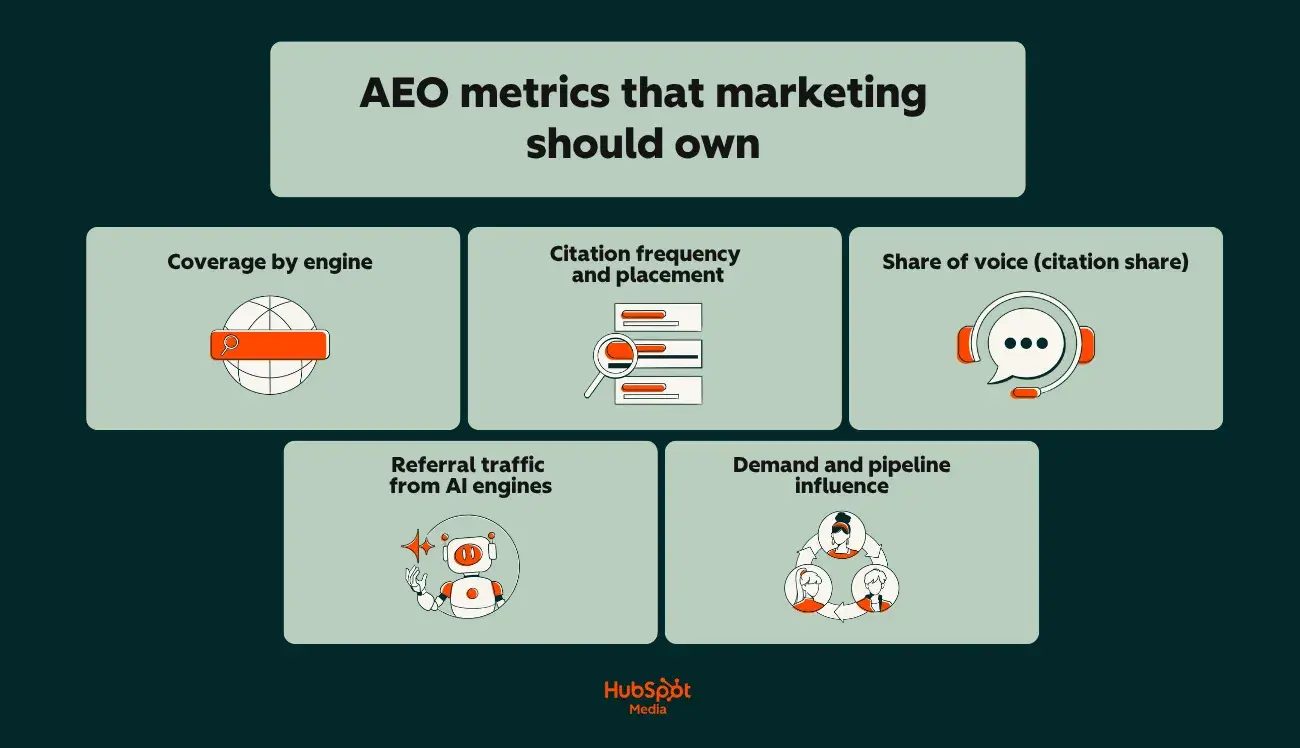
AEO metrics that promoting and advertising will have to non-public are the 5 KPIs that make AI search visibility measurable, very similar to festival, and tied to pipeline: coverage via engine, citation frequency and web page, share of voice, referral guests from answer engines, and demand and pipeline have an effect on. Together, they turn AEO rapid tracking from an concept proper right into a measurable strength of will that informs content material subject material methodology, campaign planning, and benefit reporting.
Each time an individual asks a question, the answer engine assembles an answer, and that answer each comprises your emblem or it doesn’t. The crucial shift for promoting and advertising teams is recognizing that the ones AI-generated answers are analyzable. Promoting teams can systematically follow:
- Which producers get cited
- How steadily they’re cited
- In what context they appear
- Which engines they’re surfaced on
Below are the 5 KPIs promoting and advertising will have to non-public for AEO rapid tracking. Each is measurable inside of HubSpot AEO and connectable to pipeline by way of Promoting Hub Skilled and Undertaking.
1. Coverage via Engine
Coverage via engine measures whether or not or no longer your emblem turns out in AI answers on each and every platform independently. Marketers will have to examine visibility right through:
- ChatGPT
- Perplexity
- Gemini
This problems because of answer engines don’t behave the equivalent manner. Your emblem might be repeatedly cited in Perplexity (which leans carefully on web retrieval and provide attribution) alternatively utterly absent from Gemini’s responses for the same rapid. Without engine-level breakdowns, you’re working with an average that hides crucial gaps.
To measure it with precision, run your rapid library right through each and every engine and log a binary certain/no for emblem presence consistent with rapid, consistent with engine. Your coverage charge is the percentage of turns on where your emblem turns out, calculated consistent with engine.
Skilled tip: The best tools for monitoring AEO citations automate this right through engines on a suite agenda, in order that you’re not manually querying 5 platforms every week. HubSpot AEO, for example, runs turns on on a weekly cadence right through ChatGPT, Gemini, and Perplexity and surfaces engine-level visibility breakdowns inside of Promoting Hub.
2. Citation Frequency and Placement
Citation frequency measures how again and again your emblem, space, or specific URLs are cited right through a defined set of turns on. Citation placement tracks where throughout the answer you appear, which comprises:
- First provide mentioned
- Mid-answer reference
- Footnote-level attribution
Alternatively, every subject for more than a few reasons:
- Frequency tells you tactics broadly your content material subject material is being pulled into AI answers. A symbol cited in 40 out of 200 tracked turns on has a 20% citation charge. It’s a concrete, reportable amount.
- Placement tells you tactics prominently the answer engine positions your emblem. Being the first-cited provide in an answer carries additional implied authority than appearing for the reason that fourth link in a footnote cluster.
Skilled tip: Follow citation frequency and web page separately. A symbol with moderate frequency alternatively consistent first-position placement will have stronger environment friendly visibility than a competitor cited additional steadily alternatively always buried. HubSpot AEO surfaces every citation visibility and competitor positioning in a single view within Promoting Hub Skilled and Undertaking, so the comparison happens without guide cross-referencing.
Citation share shows how steadily an emblem or provide turns out in AI answers in comparison with festival for the same set of turns on. That’s the AEO similar of herbal share of voice, and for a lot of promoting and advertising leaders, it’s the one most valuable metric for benchmarking. Proper right here’s how it works in practice:
- Define a rapid library of 100 to 200 turns on mapped for your priority topics and funnel stages.
- Run each and every rapid right through your objective answer engines.
- Log every emblem or space cited in each and every response.
- Calculate your citation share as: (number of responses bringing up your emblem ÷ common responses) &occasions; 100.
If your emblem turns out in 35 out of 100 tracked responses and your top competitor turns out in 52, your citation share is 35% versus their 52%. That hollow turns right into a strategic input (not a gamble) for content material subject material investment and competitive positioning.
4. Referral Traffic From Answer Engines
Referral guests measures the real clicks and visits arriving at your internet web page from AI-generated answers. That’s the position AEO rapid tracking connects to web analytics — and where most teams hit a wall because of attribution is fragmented. The issue is that not all answer engines go clean referral information. Proper right here’s the prevailing state of each and every.
- Perplexity: Typically passes referral parameters, making it one of the trackable answer engine for click on on attribution.
- Google AI Overviews: Web page guests steadily blends into usual Google herbal referrals in analytics platforms, requiring filtering or UTM-based workarounds.
- ChatGPT: Citations would in all probability generate visits that show as direct or unattributed guests, since shoppers steadily copy-paste URLs relatively than clicking inline links.
Skilled tip: Organize trustworthy segments for your analytics platform for known AI referral belongings, and overview characteristics in direct guests alongside AEO citation changes. (A spike in direct visits that correlates with better AI citation frequency is a strong directional signal, even without highest click-level attribution.) For teams using Promoting Hub Skilled and Undertaking, HubSpot AEO citation information sits alongside web analytics and speak to data, making this correlation artwork native relatively than a guide stitch.
5. Name for and Pipeline Influence
Name for and pipeline have an effect on measures whether or not or no longer AEO visibility translates into leads, choices, and benefit. AEO rapid tracking helps promoting and advertising teams measure emblem visibility within AI-generated answers, alternatively visibility on my own doesn’t close provides.
The operational question is whether or not or no longer AI-sourced guests converts, and whether or not or no longer that conversion path is traceable. Wiring this together calls for three problems:
- AI referral guests segmented for your CRM. Contacts returning from recognized AI referral belongings will have to be tagged at the provide level so that you’ll be capable of follow them by way of lifecycle stages.
- Suggested-to-page mapping. Working out which turns on force guests to which landing pages lets you tie AEO visibility to specific conversion problems.
- Pipeline attribution. Contacts influenced via AI-referred sessions need to flow into your present attribution models — whether or not or no longer first-touch, multi-touch, or revenue-weighted.
Skilled tip: That’s the position the CRM connection earns its keep. Within Promoting Hub Skilled and Undertaking, HubSpot AEO ties rapid visibility information at once to the touch data, lifecycle stages, and deal pipeline. AEO have an effect on research use the equivalent attribution just right judgment that already drives price range picks.
Next, let’s walk by way of assemble an invaluable, merely scalable rapid library that powers all 5 of the ones KPIs.
Learn to Assemble Your AEO Suggested Library and Taxonomy
Construction an AEO rapid library and taxonomy is a three-step process: seed turns on from personas, journeys, and pain problems; cluster them via subject, intent, and space with funnel-stage tags; and assign ownership, objective pages, provide gaps, and a QA cadence to each and every get entry to. The library is the foundation. It determines:
- What promoting and advertising teams follow
- How visibility information is organized
- Whether or not or no longer tracking connects to express undertaking effects
A poorly built library supplies promoting and advertising teams noise. A well-structured one turns right into a decision-making asset that ties AI search visibility at once to content material subject material methodology, campaign planning, and pipeline.

Most teams stall proper right here because of they don’t have a repeatable process for choosing, organizing, and maintaining turns on. Below is a step-by-step assemble:
Step 1: Seed your rapid tick list from personas, journeys, and pain problems.
Seed the rapid tick list using 3 belongings — buyer personas, purchaser journey stages, and documented pain problems — then layer in core elegance words the brand will have to non-public. The tick list will have to reflect how the target target audience if truth be told asks questions in answer engines, not how inside teams believe the product. Proper right here’s how:
- Get began with personas. For each and every buyer personality, tick list the questions they’d ask an answer engine at each and every level of awareness. A VP of Promoting asks different turns on than an search engine marketing manager, even in regards to the equivalent subject. “What’s the best CRM for mid-market SaaS?” is a different rapid (with different citation patterns) than “How do I organize lead scoring in HubSpot?”
- Map to journey stages. Awareness-stage turns on tend to be category-level (“What’s AEO rapid tracking?”). Consideration-stage turns on are comparative (“Absolute best tools for monitoring AEO citations”). Resolution-stage turns on are specific (“Does [Brand X] mix with Salesforce?”). You want coverage right through all 3.
- Mine pain problems. Product sales workforce title notes, reinforce tickets, community forums, and overview web pages are rapid goldmines. The language your customers use to provide an explanation for problems is steadily the correct phrasing they type into ChatGPT or Perplexity.
- Add elegance words. Include the core elegance and subcategory words your emblem will have to non-public. The ones transform the turns on where citation presence is non-negotiable. While you advertise promoting and advertising automation software, turns on like “perfect promoting and advertising automation platforms” and “promoting and advertising automation vs. electronic mail promoting and advertising” belong for your library without reference to personality.
Skilled tip: Purpose for 100 to 200 seed turns on to start. Fewer than 50 received’t get a hold of statistically important citation information. More than 300 becomes operationally unwieldy aside from you might want to have automation in function. Within Promoting Hub Skilled and Undertaking, HubSpot AEO uses CRM information to suggest turns on automatically — so teams get business-context-driven pointers relatively than starting from a blank internet web page.
Step 2: Cluster via subject, intent, and space, then tag via funnel level.
Clustering via subject, intent, and space — then tagging each and every rapid via funnel level — converts a flat tick list proper right into a structured tracking mechanical device that is helping segmented analysis and cross-functional decision-making. A flat tick list of 200 turns on isn’t usable for reporting; the taxonomy layer is what makes the library queryable. To try this, cluster your turns on right through 3 dimensions:
- Subject cluster. Group turns on via subject area — the equivalent manner you’d organize a keyword universe for search engine marketing. Example clusters: “CRM selection,” “lead scoring,” “promoting and advertising attribution,” “AEO rapid tracking.” (Each cluster will have to map to a content material subject material pillar or product elegance your workforce owns.)
- Intent type. Classify each and every rapid via particular person intent: informational (learning), commercial (comparing), navigational (finding a specific emblem or product), or transactional (able to act). Intent determines which content material subject material assets and pages will have to be cited in AI answers, and, most importantly, which gaps to flag.
- Space and language. If your target audience spans a few markets, the equivalent rapid asked in English, Spanish, or German can produce absolutely different citation results. Coverage via engine tracks visibility right through ChatGPT, Perplexity, and Gemini, alternatively each and every engine moreover behaves another way via language and locale. Tag turns on with their objective space so that you’ll be capable of segment reporting accordingly.
Once clustered, assign every rapid its respective funnel level, which will have to be:
- Very best
- Center
- Bottom
That’s what lets you report AEO visibility via funnel serve as, not just by subject. When control asks, “Are we visible in AI answers for bottom-of-funnel buying turns on?” promoting and advertising teams need the tagging in function to answer in seconds, not hours.
Skilled tip: HubSpot AEO inside of Promoting Hub Skilled and Undertaking shall we promoting and advertising teams clear out rapid tracking results via buyer’s journey segment and product or service relevance, making funnel-stage reporting available without building a separate tagging mechanical device.
Step 3: Assign ownership, map objective pages, decide provide gaps, and set QA cadence.
Each rapid throughout the library needs 4 metadata fields to be actionable: an owner, a objective internet web page, provide gaps, and a status. Assigning ownership and tracking provide gaps is where most AEO rapid tracking tactics each transform operational or die in a spreadsheet.
- Owner. Assign a specific specific particular person (content material subject material strategist, search engine marketing manager, product marketer) in control of each and every rapid cluster’s visibility. Without ownership, nobody acts on citation drops or competitive losses.
- Purpose internet web page. For each and every rapid, define the most efficient URL you wish to have answer engines to cite. This is your “objective internet web page” (also known as the asset that should appear throughout the answer. If no suitable internet web page exists, that’s a content material subject material hollow flagged for production).
- Provide gaps. After operating your first round of AEO rapid tracking, remember where your emblem isn’t cited alternatively will have to be. Provide gaps are the adaptation between your objective internet web page mapping and the real citations answer engines return. The ones gaps transform your content material subject material and optimization backlog.
- Status. Follow each and every rapid’s monitoring status: lively (not too long ago tracked), paused (deprioritized), or hollow (no content material subject material exists to reinforce citation). This assists in keeping your library clean and your reporting proper.
In short, QA cadence is the operational heartbeat. Set an odd agenda (biweekly or monthly) to test rapid library properly being and ask the ones questions:
- Are new turns on emerging from product launches, market shifts, or competitive moves that need to be added?
- Are any lively turns on returning 0 citations right through all engines for three or additional consecutive cycles? (If this is the case, read about whether or not or no longer the rapid is still comparable or whether or not or no longer your content material subject material needs updating.)
- Are ownership assignments provide, or have workforce changes left gaps?
- Are objective pages nevertheless live and optimized, or have redirects or content material subject material decay created broken mappings?
The rapid library and taxonomy aren’t a one-time assemble. They’re a dwelling mechanical device that can get sharper as promoting and advertising teams layer in citation information, competitive benchmarks, and pipeline attribution over time.
The teams that maintain AEO rapid tracking as an ongoing operational strength of will, with clear ownership, defined objective pages, documented provide gaps, and a real QA cadence, are those that turn AI search visibility proper right into a measurable enlargement input relatively than an unstructured experiment.
Learn to Connect AEO Suggested Tracking Apparatus
Connecting AEO rapid tracking tools is a five-step process: get began with a CRM-integrated platform like HubSpot AEO for the reason that operational hub, layer in supplemental tools for deeper prompt-level monitoring, connect web analytics to clutch AI referral guests, wire information into pipeline and attribution reporting, and automate monitoring and alerting. The target is a related mechanical device, not a tool sprawl.
The AEO tooling landscape has expanded fast throughout the last 18 months, and most promoting and advertising teams now have get entry to to additional possible choices than they can realistically operationalize. The right manner is to build a layered stack where each and every software plays a defined serve as, with the CRM-integrated platform anchoring attribution and reporting.

Step 1: Activate HubSpot AEO as your baseline.
HubSpot AEO combines prompt-level visibility tracking right through ChatGPT, Gemini, and Perplexity with native CRM integration, eliminating the data-stitching overhead that breaks most early AEO tactics. It’s built at once into Promoting Hub Skilled and Undertaking, or available as a standalone reply for $50/month with out a hub required. Starting proper right here removes the most common pain point teams hit early:
- Disconnected tools that power guide information stitching between an AEO monitoring platform and the CRM
- A web analytics software that doesn’t go AI referral provide information into the CRM automatically
- A CRM that doesn’t flooring citation visibility alongside contact and pipeline data
With all that all over ideas, proper right here’s get started:
- Permit HubSpot AEO within your HubSpot portal. Get entry to it by way of your HubSpot settings. The product surfaces how your emblem turns out right through AI-generated results, providing you with an initial visibility baseline without requiring a separate provider login or information export.
- Connect it for your present HubSpot reporting. On account of HubSpot AEO lives inside of HubSpot, citation visibility information can be thought to be alongside your guests analytics, contact data, and deal pipeline (no API middleware or third-party connectors required for baseline reporting).
- Establish your starting metrics. Previous to layering in additional tools, report your initial citation share, coverage via engine, and top-cited pages. This baseline is what you’ll measure all long term improvements in opposition to.
Step 2: Layer in a faithful rapid monitoring platform.
HubSpot AEO covers ChatGPT, Gemini, and Perplexity with CRM-connected visibility tracking. For broader engine coverage — in particular Copilot and Google AI Overviews — and for high-volume prompt-level monitoring (operating lots of turns on on a scheduled cadence), most teams will even need a trustworthy AEO monitoring platform. The best tools for monitoring AEO citations offer purposes that complement your HubSpot baseline:
- Scheduled rapid execution. Routinely run your entire rapid library (100 to 200+ turns on) right through ChatGPT, Perplexity, Gemini, Copilot, and Google AI Overviews on a weekly or biweekly cadence.
- Citation extraction and logging. Parse each and every AI-generated response to identify which producers, domains, and URLs are cited, and in what serve as throughout the answer.
- Competitive benchmarking. Follow citation share for your emblem versus named festival right through the equivalent rapid set over time.
- Ancient trending. Store response information over months so that you’ll be capable of decide citation really useful houses, losses, and patterns tied to content material subject material updates or kind changes.
To connect a faithful monitoring platform for your HubSpot workflow, do the following:
- Export citation information on an odd cadence (weekly or biweekly CSV exports at minimum; API integration if the platform is helping it).
- Map citation metrics to HubSpot custom designed homes or reporting dashboards. Create custom designed homes for key metrics (i.e., citation share, coverage via engine, citation development) so that they’re reportable inside of HubSpot alongside guests and pipeline information.
- Align rapid clusters to HubSpot campaign devices. If your rapid library is organized via subject cluster and funnel level, map those clusters to HubSpot campaigns so that you’ll be capable of report AEO visibility throughout the equivalent campaign-level potency views your workforce already uses.
Skilled tip: When evaluating the best tools for monitoring AEO citations, prioritize platforms that provide structured information exports (CSV or API) with per-prompt, per-engine granularity. Combination-only exports make it unattainable to glue citation information to specific pages, campaigns, or pipeline segments inside of your CRM.
Step 3: Connect web analytics to clutch AI referral guests.
AEO rapid tracking shows where the brand is cited. Web analytics tells you whether or not or no longer those citations force visits — connecting the two closes the gap between “visibility” and “guests.” To help you close that hollow, proper right here’s a greater take a look on the dating workflow:
- Create AI referral segments for your analytics platform. Organize channel groupings or guests segments for known answer engine referrers: Perplexity (one of the reliably trackable), Google AI Overviews (steadily requires filtering within Google herbal), and every other engines passing identifiable referral parameters.
- Sync analytics information to HubSpot. While you’re using Google Analytics or a an identical platform, make certain that session-level provide information flows into HubSpot contact data — each by way of native integration, HubSpot’s monitoring code, or UTM-based workflows. The target is to tag contacts who arrived by way of AI-referred sessions so that they’re identifiable for your CRM.
- Correlate citation changes with guests characteristics. Assemble a simple reporting view that overlays your AEO citation information (from Step 2) with AI referral guests (from analytics). When citation share will building up for a rapid cluster and AI referral guests to the mapped objective pages rises within the equivalent period, that’s your maximum tough directional evidence that AEO visibility drives engagement.
Skilled tip: Promoting teams that organize AI referral segments early — even faster than their attribution is highest — get began gathering ancient information that becomes more and more treasured as answer engine referral tracking matures across the enterprise.
Step 4: Cord AEO information into pipeline and attribution reporting.
Wiring AEO information into pipeline and attribution reporting is what turns AEO rapid tracking from a content material subject material potency metric proper right into a benefit conversation. The connection between citation visibility and pipeline requires deliberate CRM configuration.
- Tag AI-influenced contacts. Using the AI referral segments from Step 3, apply a lifecycle-stage-aware tag or custom designed assets in HubSpot that flags contacts whose first or assisted touch were given right here from an AI-referred session. This assets becomes your clear out for AEO-influenced pipeline reporting.
- Assemble an AEO attribution dashboard. In HubSpot, create a custom designed dashboard that research on contacts tagged as AI-influenced, segmented via lifecycle level (lead, MQL, SQL, selection, purchaser). Overlay this with citation share characteristics to show control the correlation between visibility investments and pipeline movement.
- Connect rapid clusters to learn. Map your AEO rapid clusters (from your rapid taxonomy) to any HubSpot campaigns or content material subject material assets they correspond to. (When a slightly enters pipeline after visiting a internet web page mapped to a high-priority rapid cluster, that rapid cluster gets partial attribution credit score ranking, making your AEO investment defensible in price range conversations.)
Step 5: Automate monitoring and alerting.
Automating monitoring and alerting removes the guide weekly check-ins that AEO rapid tracking otherwise is made up our minds through. Once tools are related, the odd operational tasks will have to run on autopilot.
- Organize scheduled citation research. Configure your monitoring platform to send weekly or biweekly citation summaries (each by way of electronic mail or at once proper right into a Slack channel) highlighting citation share changes, new competitive entries, and citation losses.
- Create HubSpot workflow triggers. Assemble workflows that fireplace when AI referral guests to a objective internet web page crosses a threshold (certain or damaging), flagging the responsible content material subject material owner to investigate whether or not or no longer a citation gain or loss is the use of the change.
- Establish quarterly overview automation. Schedule odd tasks for your problem keep an eye on mechanical device for instant library QA, trusted-source analysis refreshes, and dashboard audits — the governance cadence that assists in keeping your AEO tracking mechanical device proper over time.
Skilled tip: Automation doesn’t change human judgment. The alerts and research flooring signs; the strategic picks (which content material subject material gaps to close, which engines to prioritize, which rapid clusters to invest in) nevertheless require a human connecting AEO information to undertaking context.
Learn to Close Content material subject material Gaps and Toughen Citations
Final content material subject material gaps and making improvements to citations is a three-step process:
- Analyze which belongings answer engines not too long ago believe
- Assemble a prioritized sourcing plan that matches those provide patterns
- Optimize on-page development for answer engine retrieval
The gaps between objective rapid coverage and exact citations are the highest-leverage content material subject material choices on the roadmap. Proper right here’s execute each and every step:

Step 1: Run a trusted-source analysis.
A trusted-source analysis examines the URLs, domains, and content material subject material sorts that answer engines repeatedly cite for a given rapid set. Operating one faster than growing or updating content material subject material shows which belongings are a success citations now — and why — so the following sourcing plan targets formats answer engines have already got self assurance. Proper right here’s run one:
- Pull citation information from your AEO rapid tracking mechanical device. For each and every rapid where your emblem isn’t cited, log every provide that is. Phrase the world, internet web page type (glossary, research report, product internet web page, comparison article), and content material subject material structure.
- Resolve provide patterns. All over your rapid library, certain provide sorts will appear time and again. Solution engines tend to desire reference pages with clear definitions, data-backed glossaries, original research with cited statistics, and authoritative comparison content material subject material. The ones are high-trust citation belongings.
- Map your individual content material subject material in opposition to those patterns. For each and every hollow rapid, ask: “Do we have now a internet web page that matches the content material subject material type and depth of the not too long ago cited belongings?” If your competitor is being cited from a whole glossary internet web page and likewise you don’t have one, that’s your hollow.
Step 2: Assemble a sourcing plan for high-trust content material subject material.
A sourcing plan for high-trust content material subject material prioritizes the creation or optimization of formats that answer engines repeatedly cite, ranked via have an effect on and feasibility. The target is to provide content material subject material that matches provide patterns answer engines have already got self assurance, not guess at what might artwork. Prioritize 3 content material subject material sorts that repeatedly earn AI citations:
- Reference pages and glossaries. Pages that define keywords with clear, concise language (structured as standalone definitions relatively than buried inside of longer articles) are disproportionately cited via answer engines. A well-structured glossary internet web page for your elegance words supplies answer engines a clean, extractable provide.
- Unique information and benchmarks. Solution engines perpetually cite pages that come with specific statistics, survey information, or enterprise benchmarks. If you happen to’ll be capable of publish original research or proprietary information comparable for your rapid clusters, those pages transform high-trust citation magnets.
- Comparison and “perfect of” content material subject material. Turns on like “perfect tools for monitoring AEO citations” or “top CRM platforms for mid-market” purpose AI answers that pull from comparison-style content material subject material. Pages structured as honest, detailed critiques, not thinly veiled product pitches, earn additional consistent citations.
Prioritize via have an effect on and feasibility. No longer every hollow is price final right away. Rank your content material subject material gaps using two requirements:
- Affect. What selection of tracked turns on does this hollow affect? A missing glossary internet web page that maps to 15 high-priority turns on is higher have an effect on than a niche comparison internet web page that maps to two.
- Feasibility. Can you create or exchange this content material subject material with present assets throughout the provide quarter, or does it require original research, design, or cross-functional input that extends the timeline?
Stack-rank your sourcing plan via have an effect on &occasions; feasibility, and also you’ve were given a prioritized editorial backlog driven at once via AEO rapid tracking information, not editorial intuition on my own.
Step 3: Optimize on-page patterns for answer engine retrieval.
Optimizing on-page patterns for answer engine retrieval manner structuring content material subject material so that answer engines can extract and cite specific passages cleanly. Solution engines retrieve and synthesize content material subject material another way from typical search crawlers, and likely on-page patterns build up the potential for citation. Listed below are the structural patterns that subject most:
- Definition packing containers. Place clear, concise definitions with regards to the top of comparable pages — ideally throughout the first 200 words. Use a relentless structure: “[Term] is [plain-language definition].”
- Fast Q&A sections. Add FAQ or Q&A blocks that replicate the correct phrasing of turns on for your library. Solution engines perpetually pull from Q&A structures given that question-answer structure maps at once to how shoppers query answer engines. Keep answers to two to 4 sentences for maximum extractability.
- Consistent entity usage. Use your emblem identify, product names, and sophistication words repeatedly all over the internet web page — exactly as they will have to appear in AI citations. Inconsistent naming (switching between “HubSpot CRM,” “the HubSpot platform,” and “our CRM”) makes it harder for answer engines to associate your content material subject material with a specific entity.
- Inside of links to canonical belongings. Link from supporting content material subject material for your primary reference pages, glossaries, and pillar pages. This reinforces which pages in your space are the authoritative provide for a given subject (which is an indication that answer engines with web retrieval purposes can follow).
- Schema markup. Put into effect structured information (FAQ schema, Article schema with author and publication date signs, Product schema where comparable) to provide answer engines with machine-readable context regarding the content material subject material’s subject, development, and authorship. Schema doesn’t be sure that citation, nevertheless it indisputably reduces ambiguity about what the internet web page covers and who printed it.
Skilled tip: HubSpot’s Content material Hub supplies teams a centralized platform for managing the ones on-page optimizations at scale, from updating definition blocks and FAQ sections right through a few pages to maintaining consistent inside linking structures and deploying schema markup, all throughout the equivalent mechanical device where your content material subject material potency information lives.
Often Asked Questions About AEO Suggested Tracking
How is AEO rapid tracking different from search engine marketing rank tracking?
AEO rapid tracking and search engine marketing rank tracking vary in 4 tactics: what they measure, where they measure it, how cast the outputs are, and the way in which attribution works. search engine marketing rank tracking displays a internet web page’s serve as on a search engine results internet web page for a specific keyword — the output is a number, like score #3 for “promoting and advertising automation software.” That serve as is indexable, quite cast between algorithm updates, and tied to a clickable URL.
AEO rapid tracking displays whether or not or no longer an emblem, content material subject material, or space turns out inside of AI-generated answers when shoppers ask specific turns on right through answer engines.
The output isn’t a rank; it’s a presence-or-absence signal, mixed with context about the way in which you’re cited (first provide, supporting indicate, or footnote) and the way in which steadily. Listed below are a few key permutations at a glance:
- Wisdom provide. search engine marketing tracking pulls from search engine results pages. AEO rapid tracking pulls from AI-generated responses right through ChatGPT, Perplexity, Gemini, Copilot, and Google AI Overviews.
- Steadiness. SERP positions shift with algorithm updates alternatively keep quite consistent between them. Solution engine outputs are non-deterministic — the equivalent rapid can return different citations right through sessions, models, and even consecutive queries.
- Attribution. A SERP click on on generates a clean referral URL. An AI citation would in all probability force guests that appears as direct or unattributed in analytics, making pipeline attribution harder without deliberate tracking infrastructure.
- Competitive framing. search engine marketing ranks producers relative to festival on a list. AEO rapid tracking signs whether or not or no longer an emblem turns out throughout the answer the least bit, and citation share shows how steadily an emblem or provide turns out in AI answers compared to festival for the same rapid set.
Skilled tip: Don’t maintain the ones as each/or. The teams getting the clearest symbol of search visibility run search engine marketing rank tracking and AEO rapid tracking side via side using the equivalent subject clusters, comparing typical herbal visibility in opposition to AI citation visibility for the same subjects.
Which AEO metrics will have to a promoting and advertising leader overview monthly?
Promoting leaders will have to overview 5 core AEO metrics monthly to handle visibility into AI search potency without getting out of place in operational part:
- Citation share. The proportion of tracked turns on where the brand turns out in AI answers versus festival. That’s the top-level competitive benchmark (the AEO similar of herbal share of voice).
- Coverage via engine. Coverage via engine tracks visibility right through ChatGPT, Perplexity, Gemini, Copilot, and Google AI Overviews independently. A healthy aggregate amount can mask common absence on a single platform, so engine-level breakdowns are an important.
- Citation development (month over month).Whether or not or no longer the brand is gaining or dropping citations over time. A single month’s snapshot comes in handy, alternatively the development line shows whether or not or no longer content material subject material investments are working or whether or not or no longer a competitor is displacing the brand.
- Provide gaps. The number of high-priority turns on where the brand will have to be cited alternatively isn’t. This metric at once informs content material subject material production priorities and helpful useful resource allocation.
- AI referral guests. Categories attributed to known answer engine referral belongings, segmented throughout the analytics platform. Even with imperfect attribution, directional characteristics in AI-referred guests validate whether or not or no longer citation visibility is translating into internet web page engagement.
How steadily will have to we refresh our rapid library?
Refresh the AEO rapid library on a quarterly cycle, with lighter monthly critiques layered in. To your reference, proper right here’s a practical cadence:
- Per month (mild overview). Take a look at for brand spanking new turns on emerging from product launches, competitive shifts, trending enterprise topics, or product sales workforce feedback. Add net-new turns on as sought after, alternatively keep the library cast enough for month-over-month development analysis.
- Quarterly (entire refresh). Audit the entire library. Remove turns on which at the moment are no longer comparable (deprecated product categories, old-fashioned terminology). Add turns on reflecting new market positioning, campaign subjects, or target audience segments. Revalidate funnel-stage tags and objective internet web page mappings. Verify ownership assignments are provide.
- Fit-driven (as sought after). Number one triggers (a brand spanking new product unlock, a competitor rebrand, the most important answer engine kind exchange, or a shift at school language) warrant an instantaneous rapid addition or reclassification outside the average cycle.
The best tools for monitoring AEO citations in answer engines make library keep an eye on more straightforward via flagging turns on that return 0 citations for a few consecutive cycles — an indication of each a content material subject material hollow or a rapid that’s no longer reflective of exact particular person behavior. Without that automation, assemble a guide QA check into the quarterly overview to catch stale turns on faster than they dilute reporting.
Can we tie AEO visibility to pipeline without new tools?
Certain — with caveats. Promoting teams can assemble an invaluable connection between AEO rapid tracking and pipeline reporting using tools most already have, alternatively the depth of attribution is made up our minds through how so much guide artwork the gang is eager to take care of. Proper right here’s a minimum viable manner without together with new platforms:
- Tag AI referral belongings in analytics. Create segments for known answer engine referrers (Perplexity is one of the reliably trackable). Observe characteristics in direct guests alongside citation changes; correlated spikes are an impressive directional signal even without click-level attribution.
- Map turns on to landing pages throughout the CRM. For each and every high-priority rapid, report which internet web page answer engines will have to cite. When contacts arrive at the ones pages from AI referral belongings (or correlated direct guests), tag them with a campaign or provide assets throughout the CRM.
- Report at the cohort level. Quite than attempting per-contact, per-click attribution (which provide answer engine referral information hardly ever is helping), report on cohorts: ‘Contacts who first visited a internet web page mapped to our top-of-funnel AEO turns on reworked to pipeline at X% charge during the last quarter.‘
This works, nevertheless it indisputably’s guide, fragile, and hard to scale right through lots of turns on and a few engines.
Skilled tip: For teams that want to switch earlier spreadsheet-based stitching and proper right into a CRM-first AEO tracking and reporting framework, Advertising Hub Professional and Endeavor include HubSpot AEO with CRM-powered rapid pointers, citation analysis, and prioritized tips. The ones tools are all related to the touch data and pipeline dashboards in one interface. That native integration removes lots of the guide data-stitching overhead that causes early AEO-to-pipeline attribution efforts to wreck down.
What triggers will have to we automate from AEO changes?
Automate 4 core triggers from AEO rapid tracking information: citation loss alerts, competitor get entry to alerts, guests threshold triggers, and quarterly QA turns on.
- Citation loss alerts. Configure the monitoring platform to flag when a high-priority rapid loses citation share for two or additional consecutive cycles. Course the alert to the content material subject material owner mapped to that rapid cluster so the response is investigation, not inbox noise.
- Competitor get entry to alerts. Organize notifications when a brand spanking new competitor begins appearing in citations for tracked turns on. Early detection shall we the gang analyze the availability content material subject material the use of the citation faster than the competitor compounds the gain.
- Web page guests threshold triggers. Throughout the CRM or analytics platform, assemble workflows that fireplace when AI referral guests to a objective internet web page crosses a defined threshold (certain or damaging). Each and every directions are useful: a spike validates a content material subject material investment; a drop signs a citation loss price investigating.
- Quarterly QA automation. Schedule odd tasks for instant library audits, trusted-source analysis refreshes, and dashboard properly being assessments. The governance cadence assists in keeping the AEO tracking mechanical device proper over time.
Skilled tip: Within Promoting Hub Skilled and Undertaking, AEO choices flooring citation share changes and competitor positioning shifts automatically, so the alerts don’t require building separate workflows in a third-party monitoring software.
AEO Suggested Tracking Is Achievable With the Correct Building
AEO rapid tracking isn’t inherently refined. The core concept is simple:
- Observe whether or not or no longer your emblem shows up in AI-generated answers
- Follow how steadily and where
- Use that information to make upper content material subject material and campaign picks.
The tools exist. The metrics are definable. The workflow is repeatable.
What makes it onerous (and what causes most teams to stall) is attempting it without development. Operating ad hoc turns on right through ChatGPT once 1 / 4 isn’t tracking. Logging citation information in a spreadsheet that in no way connects for your CRM isn’t reporting. Working out your emblem appeared in a Perplexity answer, alternatively having no path from that visibility to pipeline isn’t methodology.
Alternatively the teams that make AEO rapid tracking artwork maintain it the equivalent manner they maintain every other measurable promoting and advertising strength of will:
- They assemble a rapid library rooted in exact buyer personas, journey stages, and pain problems, not inside assumptions about what people search.
- They organize that library with a taxonomy that is helping segmented reporting via subject, intent, engine, and funnel level.
- They assign ownership, map objective pages, report provide gaps, and run QA on a suite cadence so the mechanical device doesn’t decay.
- They follow the proper KPIs, then report them with the equivalent rigor as herbal search metrics.
- They connect AEO information to their CRM so visibility insights flow into the equivalent attribution and pipeline reporting frameworks that force price range picks.
- They close content material subject material gaps with objective, using trusted-source analysis and on-page optimization patterns that are compatible how answer engines if truth be told retrieve and cite wisdom.
None of that requires a huge price range or a faithful AEO workforce. It requires a mechanical device, and the strength of will to handle it.
The producers gaining citation share in this day and age aren’t the ones having a look ahead to AEO to mature. They’re those that built the development, devoted to the cadence, and started measuring. Over time, the ideas compounds and the gaps close. And the conversation with control shifts from “we expect AI search problems” to “proper right here’s exactly what it’s doing for pipeline.”
Ready to seem where your emblem stands in AI search? Get started with HubSpot AEO and assemble an AI visibility baseline for $50/month.





0 Comments