

For individuals who’ve however to seize Claude Cowork abilities, let me will mean you can out: Claude Cowork is a technique that can get right to use your desktop knowledge and whole tasks for you. A ability is a set of instructions that tell Claude exactly learn to perform a decided on workflow. When combined, the two can boost your productivity one way or the other that Claude Chat on my own can’t.
Claude talents aren’t limited to a minimum of one Claude flooring or tool. Abilities art work in Claude Chat, Claude Code, and Claude Cowork. So “Claude Cowork abilities” are in fact a feature across the AI, now not just a single mode.

This is much more true since Anthropic introduced that Claude Cowork, Chat, Artifacts, and Design are merging proper right into a single unified revel in, starting in October 2026. Abilities, tasks, connectors, and tasks all carry over, then again shoppers not have to dance between tabs. Claude simply decides which tools to use in line with what you ask.
The ones changes are meant to cut back confusion, then again it’s natural to nevertheless have questions. We’ll clear problems up as they stand now, share what Claude Cowork abilities are, and what you should assemble to get necessarily probably the most out of them.
Practice: The ones changes are rolling out to Claude’s Skilled and Max plans first, on the net, desktop, and cell over the impending weeks, with plans to extend them to the unfastened and group tiers later.
Table of Contents
- What are Claude Cowork talents?
- Claude Talents vs. Tasks vs. Directions vs. Reminiscence
- How Claude Cowork Talents Paintings
- Find out how to Create Your First Claude Cowork Ability
- Claude Cowork Talents: Best possible Makes use of for Earnings Groups
- Claude Cowork Best possible Practices for Protection and Reliability
- Attach Claude to HubSpot
- Continuously Requested Questions About Claude Cowork Talents
- All it takes is one talent to begin.
What are Claude Cowork abilities?
A Claude Cowork Talent is a reusable instruction folder (with optional supporting templates, scripts, or reference forms attached) that Claude such a lot when a job needs it, and ignores when it doesn’t. You’ll use Claude Cowork abilities all over each other Claude flooring, so truly, any Claude ability is a Claude Cowork ability and vice versa.
If you want to get into the nuts and bolts of it, a Claude ability is technically a folder that can include the following:
- Instructions: the step-by-step procedure and the principles Claude should stick with.
- Templates and reference knowledge: brand guidelines, development outputs, or layouts that show the standard to test.
- Scripts: code for the deterministic parts, corresponding to reformatting knowledge or generating a document.
What makes a ability different from an intensive suggested you paste each time is:
- It’s transportable. One ability works in Chat, Cowork, and Claude Code; you don’t rewrite it for each flooring. You’ll moreover use Claude abilities in other AI or LLM gear like ChatGPT.
- It’s consistent. Claude follows the an identical steps, within the an identical order, each time. No glide, no improvising.
- It’s just right about context. Claude only such a lot what it needs, which keeps the conversation targeted and setting pleasant.
On account of Cowork and the new merger, a ability can now moreover get right to use inside of documentation and do things like learning and writing to folders for your computer, working multi-step tasks autonomously, coordinating sub-agents, and producing finished knowledge like spreadsheets and shows, now not merely responding in text find it irresistible would with Chat on my own.
When you want Claude to replicate a multi-step process the an identical means each time (i.e., formatting a weekly report, triaging leads, summarizing strengthen tickets), that’s where a ability is useful.
For example, once I’m using Claude for fact-checking assist, I continuously suggested it with detailed instructions on what to ensure throughout the article, how to ensure it, and what to include in its citations so that I will be able to double-check its art work. As an alternative of repeating that suggested each single time I’m completed with an article, I’ve a “blog-fact-checker” ability that comprises my detailed instructions. Now, instead of 500 words, I simply type two words, “Fact check,” and attach my draft by way of Google Docs. Easy.
Practice: Report a Talent is a Cowork feature nevertheless distinctive to Claude Cowork on Mac desktops with Skilled, Max, and Team plans, then again we’ll get into that later.
Where to Get entry to Claude Abilities
Claude mechanically selects and uses abilities depending on the context. You don’t have to tell it when to use a ability or which one to invoke, even supposing you can do so in a few ways:
1. When creating a ability, you’ll include particular wording throughout the ability description on how Claude can know when to invoke the ability (Anthropic recommends writing in 1/3 individual). Example: “Use this ability each and every time the patron says ‘generate an image,’ ‘make an infographic,’ or ‘create an image.’”
2. Add the instructions in your suggested. Example: “Use your infographic ability to create a bar chart showing the per 30 days product sales comparison.”
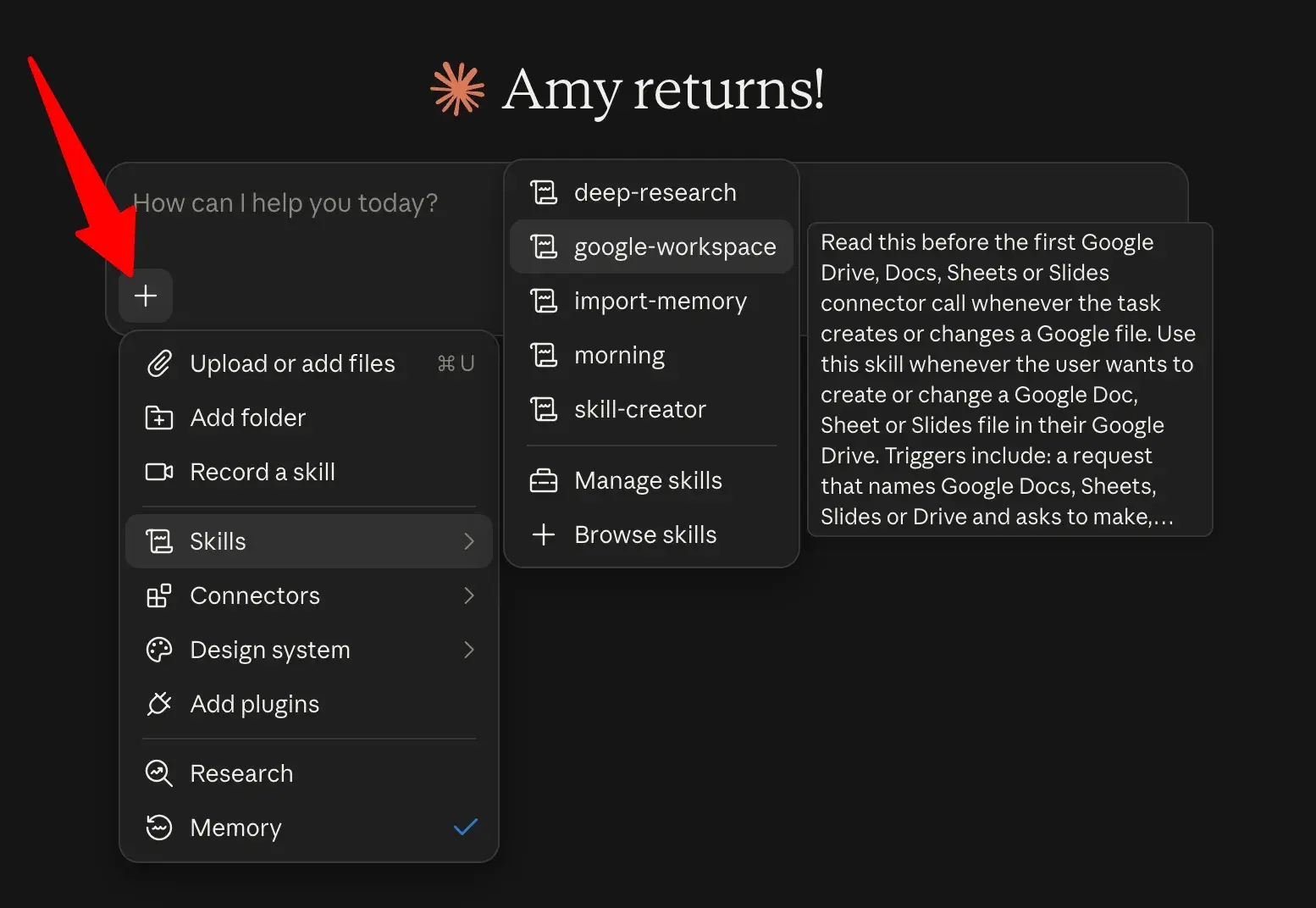
3. Click on at the
+ icon to the lower left of the chat, hover over
Abilities, and make a selection the ability you want from the menu.
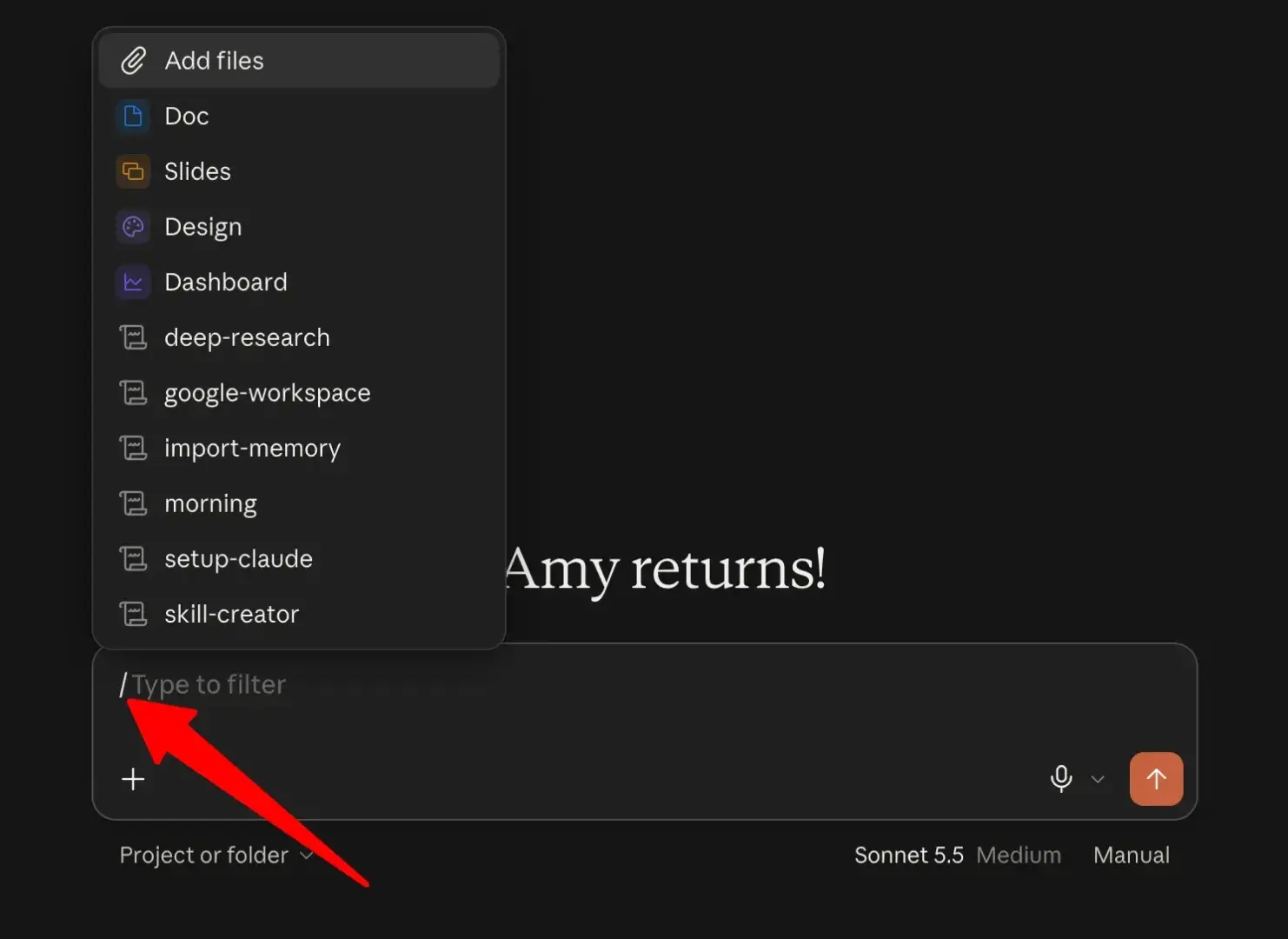
4. Type a forward slash (
/) throughout the chat, and your entire abilities will pop up in a dropdown menu, allowing you to select the one(s) you’d like to use.
Claude Abilities vs. Duties vs. Instructions vs. Memory
As a marketer, I’m continuously crushed by the use of the sheer number of choices that Claude supplies (and new ones get introduced it seems that each week!). So, proper right here’s a to hand information a coarse demystifier on the difference between Claude abilities, tasks, instructions, and memory.
- Memory is what Claude learns from your chats (each mechanically or because you suggested it to remember). There may be project-specific memory, where Claude will take into accout knowledge comparable only to that specific assignment.
- Abilities are repeatable instructions that can be invoked explicitly (you tell Claude to use it) or implicitly (Claude mechanically figures out which abilities are sought after for that task). Abilities are usable all over your tasks and tasks.
- Duties are folders that organize similar tasks and chats by the use of topic, each protecting its non-public knowledge and context.
- Instructions are huge directives that shape how Claude works, each account-wide by the use of default or project-specific.
Which one you utilize depends upon what downside you’re working into:
- For individuals who keep retyping the an identical suggested, create a ability.
- If you want to have your knowledge and advertising marketing campaign context in one place, create a assignment.
- If you want to have Claude to remember a very powerful component all over chats, add it to memory.
- If you want to have Claude to behave a certain means each time, write instructions.
As Alex Banks places it: “Abilities are the tools throughout the workshop. Duties are the workshop itself.”
The ones 4 can also be combined: A single assignment can carry its non-public instructions and project-specific memory whilst you invoke abilities inside of it.
Claude plugins bundle abilities, MCP connectors, directions, and agents into one package.
How Claude Cowork Abilities Artwork
Together with a ability doesn’t “retrain” or “fine-tune” Claude, and it doesn’t trade how the fad thinks. A ability is just a set of task-specific instructions Claude reads these days you want them, like handing a colleague an SOP and asking them to stick with it.
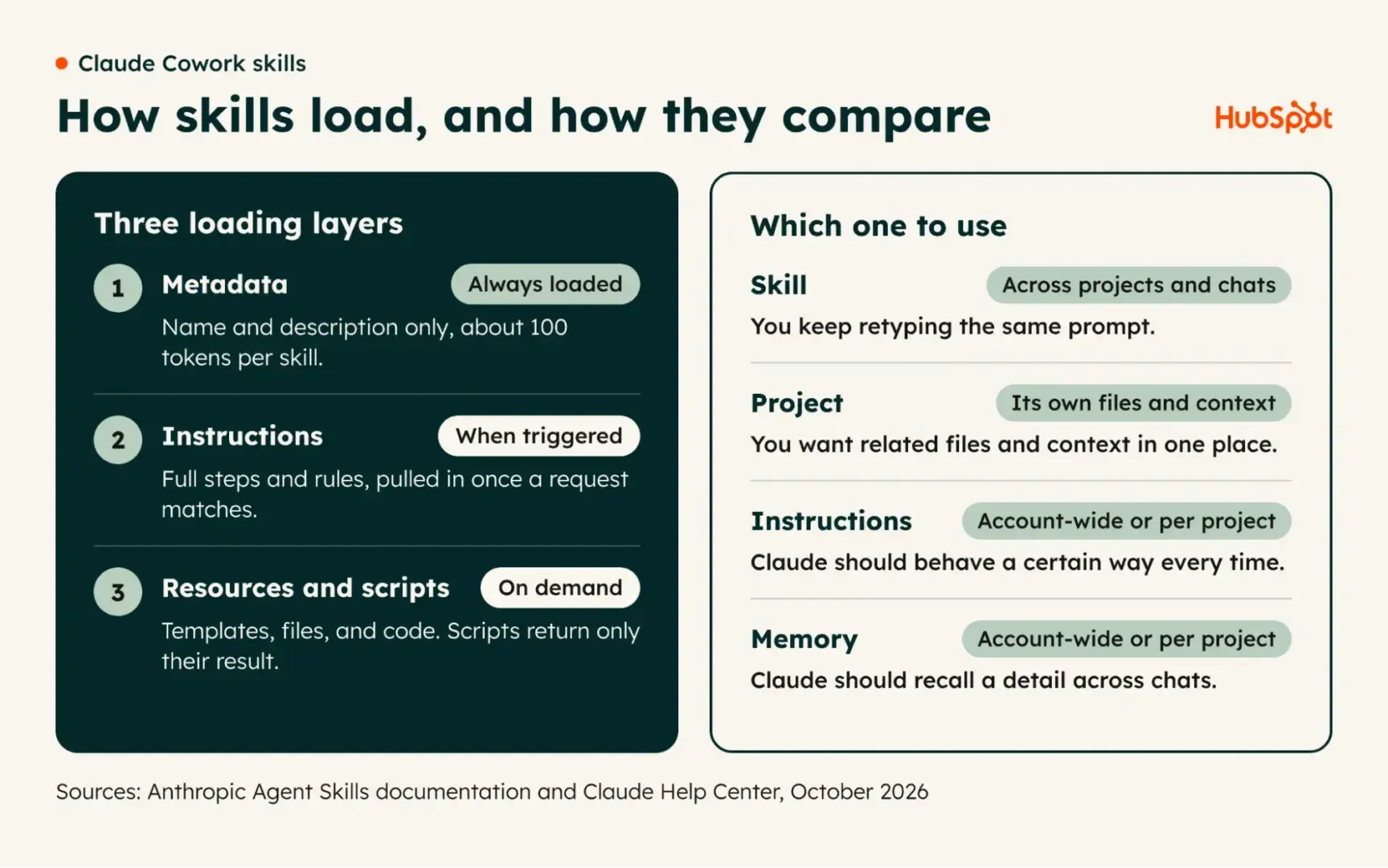
Claude reads the ability using revolutionary disclosure: It brings a ability into the session piece by the use of piece as sought after, moderately than hastily. Progressive disclosure works in 3 stages:
- Metadata (all the time on): At startup, Claude such a lot only each ability’s establish and description. That’s the best way it’s acutely aware of which abilities exist and when to succeed in for one, and it’s why you’ll keep dozens installed without slowing the remainder down.
- Instructions (loaded when precipitated): Once your request strains up with a ability’s description, Claude pulls throughout the whole instruction set, along side the steps, rules, and formatting it should stick with.
- Belongings and scripts (loaded on name for): The templates, reference knowledge, and code throughout the ability folder stay put until a job calls for them, so that they worth no longer the rest until used. When Claude runs a script, only the result enters the chat, now not the code itself.
The advantage of this is {{that a}} ability can bundle large brand guidelines, datasets, or utilities without slowing down each conversation, because of none of it such a lot until Claude needs it.
Learn how to Create Your First Claude Cowork Talent
This article covers two ways to create a Claude Cowork ability:
- Advised Claude in conversation to build a ability in line with your specifications.
- Use “Report a ability” in Claude for Mac desktop app and let Claude assemble a ability in line with the video recording.
If you already have a ability document, you’ll moreover add it as a ZIP from Customize > Abilities.
Once I first learned about Claude Cowork abilities, I had a difficult time deciding what exactly I should turn into a ability. For individuals who’re within the an identical boat, I love to counsel starting with any saved turns on or those you over and over type. Comb by way of your old-fashioned chats and Claude tasks and see what turns on or instructions you frequently use. Or if you have a suggested library in a spreadsheet or report, mine that for ideas of what you’ll turn into a ability.
You’ll moreover spend someday watching what tasks you over and over carry out then again have under no circumstances documented. Grab the ones workflows by the use of using Claude’s “Report a ability.”
When to Use “Report a Talent”
Claude for Mac’s “Report a ability” feature could be very highest for multi-step workflows you do all the time then again have under no circumstances formally documented. The rest where you’ll report a screenshare video while verbally walking by way of each step in beneath ten minutes is an ideal candidate. Some examples:
- Webinar lead routing: Kind an attendee export into product sales, customer just right fortune, and promoting and advertising follow-up (the ability I’ll report underneath).
- Protection questionnaire first pass: Have compatibility a prospect’s questions in your approved answers and flag any without one.
- Refund request evaluate: Assessment each request against your refund protection and mark it Approve or Escalate.
Learn how to Use “Report a Talent”
Beneath, I’ll walk you during the stairs to use the “Report a ability” feature to make your first Claude Cowork ability. To show off, I created a examine ability for routing webinar leads for a fictional company using fake contacts.
Very important steps previous than you get started:
- Take a look at that it’s good to have the Skilled, Max, or Team plan and are using Cowork throughout the Claude for Mac or Home windows desktop app. “Report a ability” is now not available on Unfastened or Endeavor plans, and it is going to perhaps’t be accessed by way of Claude Chat (will have to you don’t however have the unified Cowork/Chat enjoy).
- Take a look at that Code execution and report advent is became on beneath Settings > Purposes. For individuals who’re on an Endeavor account, an Owner will have to allow Code execution and document creation along with Abilities in Crew settings > Plugins & abilities.
- Cover any passwords, secrets and techniques and methods, non-public conversations, or other refined wisdom previous than you hit report. In every single place the session, “Report a ability” captures the whole thing for your visual display unit and what you are saying aloud, so Anthropic warns towards showing refined wisdom.
- Ensure that the process you’re about to report does now not take more than 10 minutes — the recording will bring to a standstill at spherical 10 minutes.
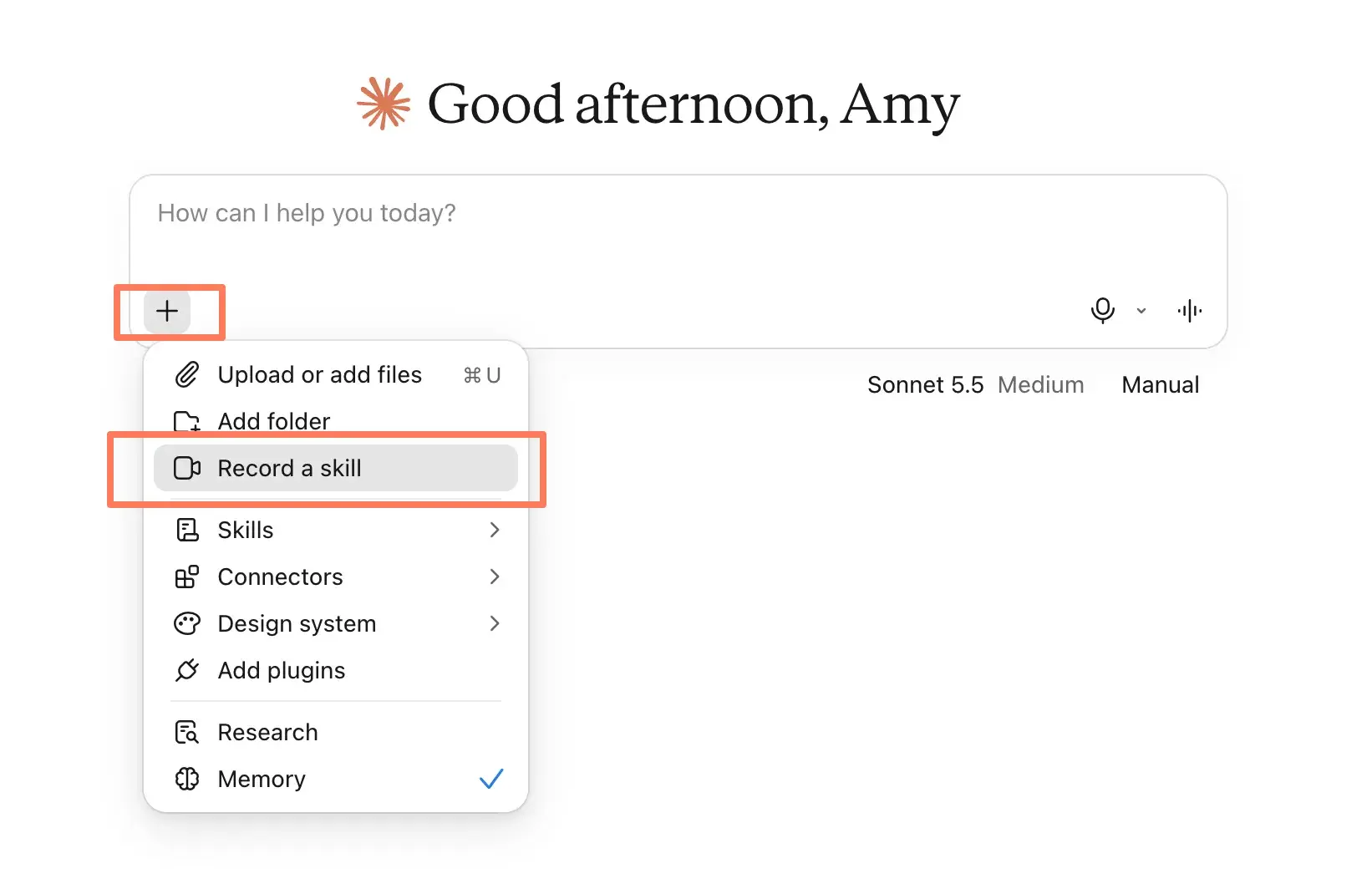
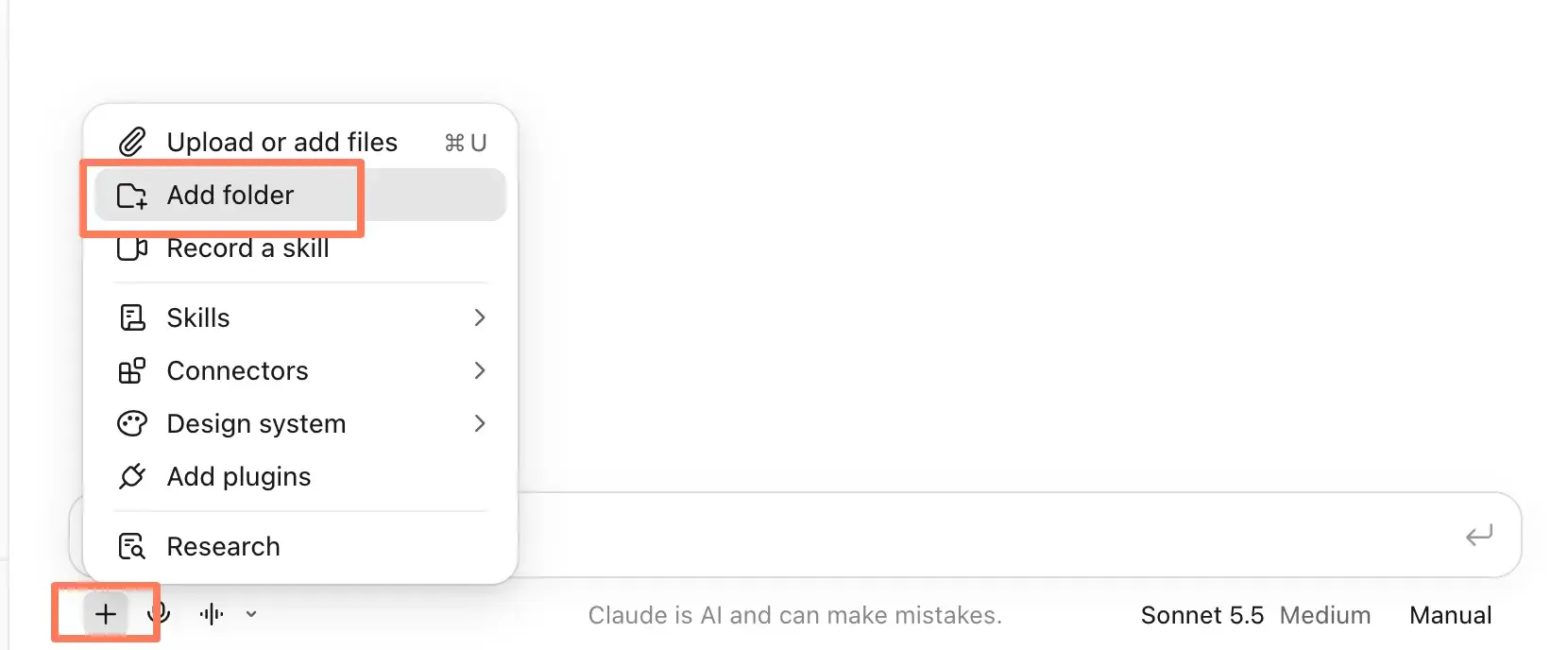
1. In a Claude desktop app session, click on on + and make a selection Report a ability from the dropdown menu.
2. You’ll get a pop-up. Click on at the Get began recording button.
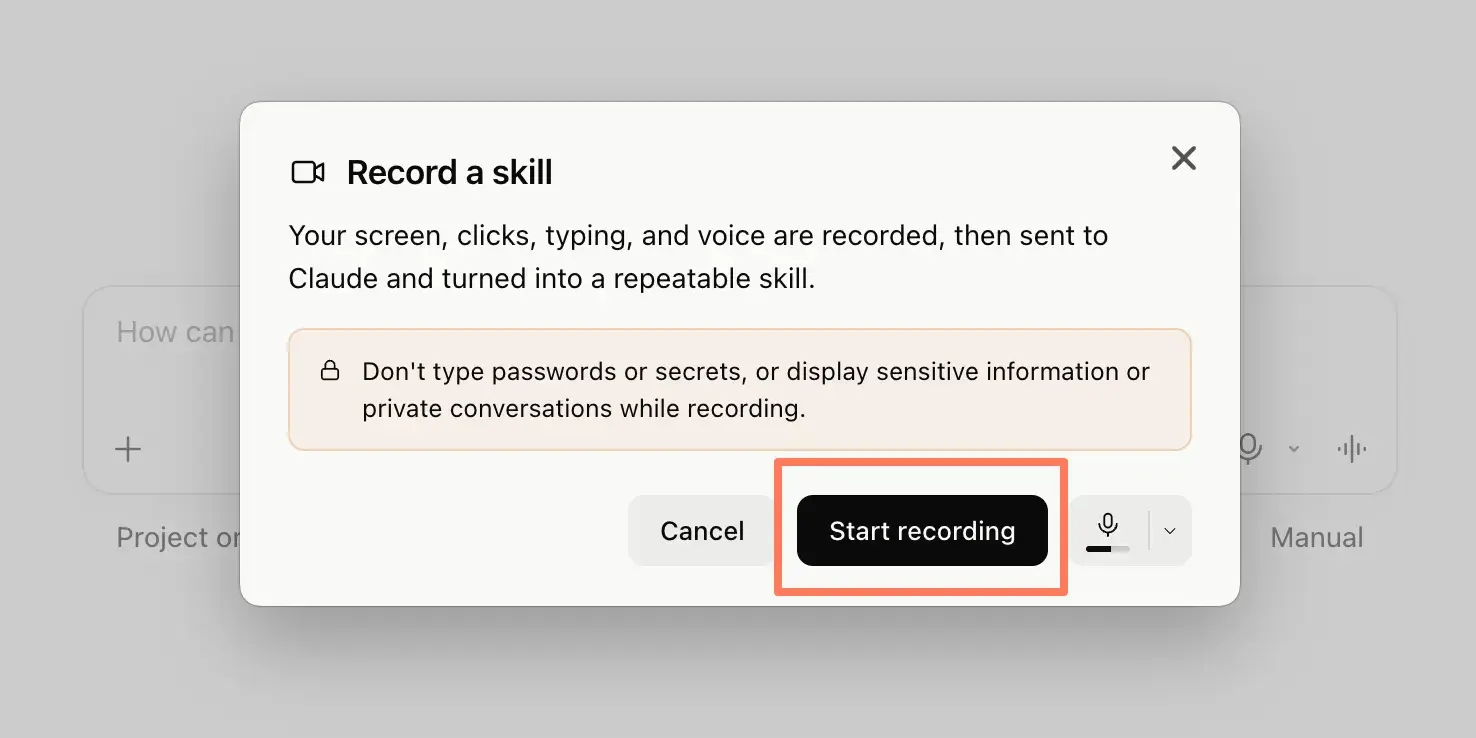
3. Get began showing the workflow you want to turn into a ability, and remember to narrate each step that you simply’re taking. Recall to mind it like filming a Loom for a coworker — you want to provide the entire context so Claude is acutely aware of why you most likely did each issue. You’ll know Claude is recording when a coral-colored halo surrounds your visual display unit, and an overlay turns out at the bottom showing “Taking pictures” and a timer.
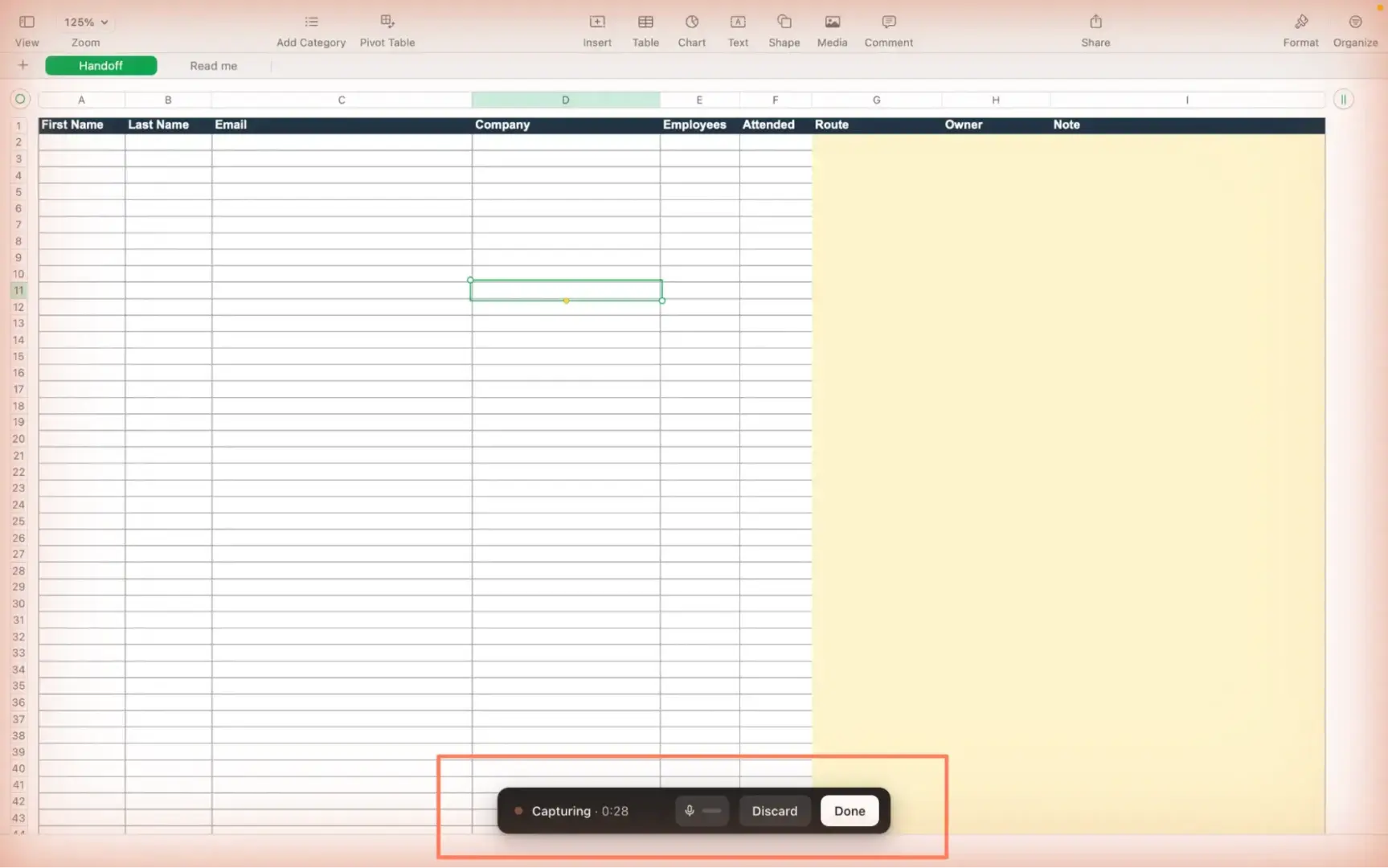
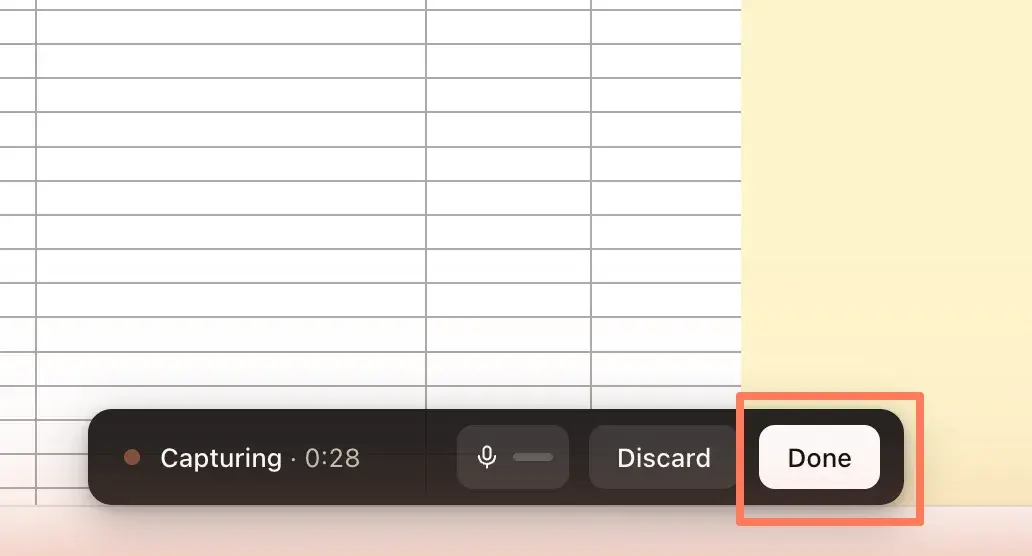
4. While you’re completed showing the workflow, click on at the Achieved button.
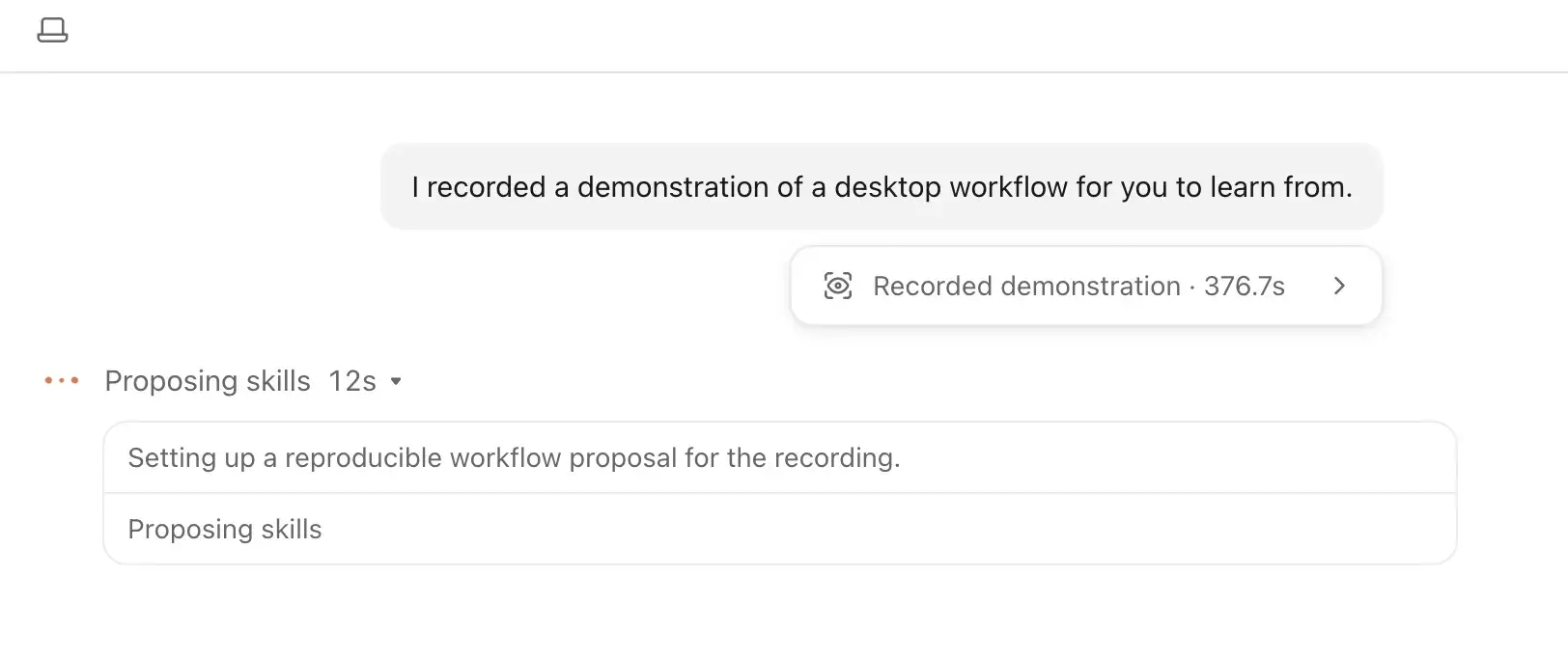
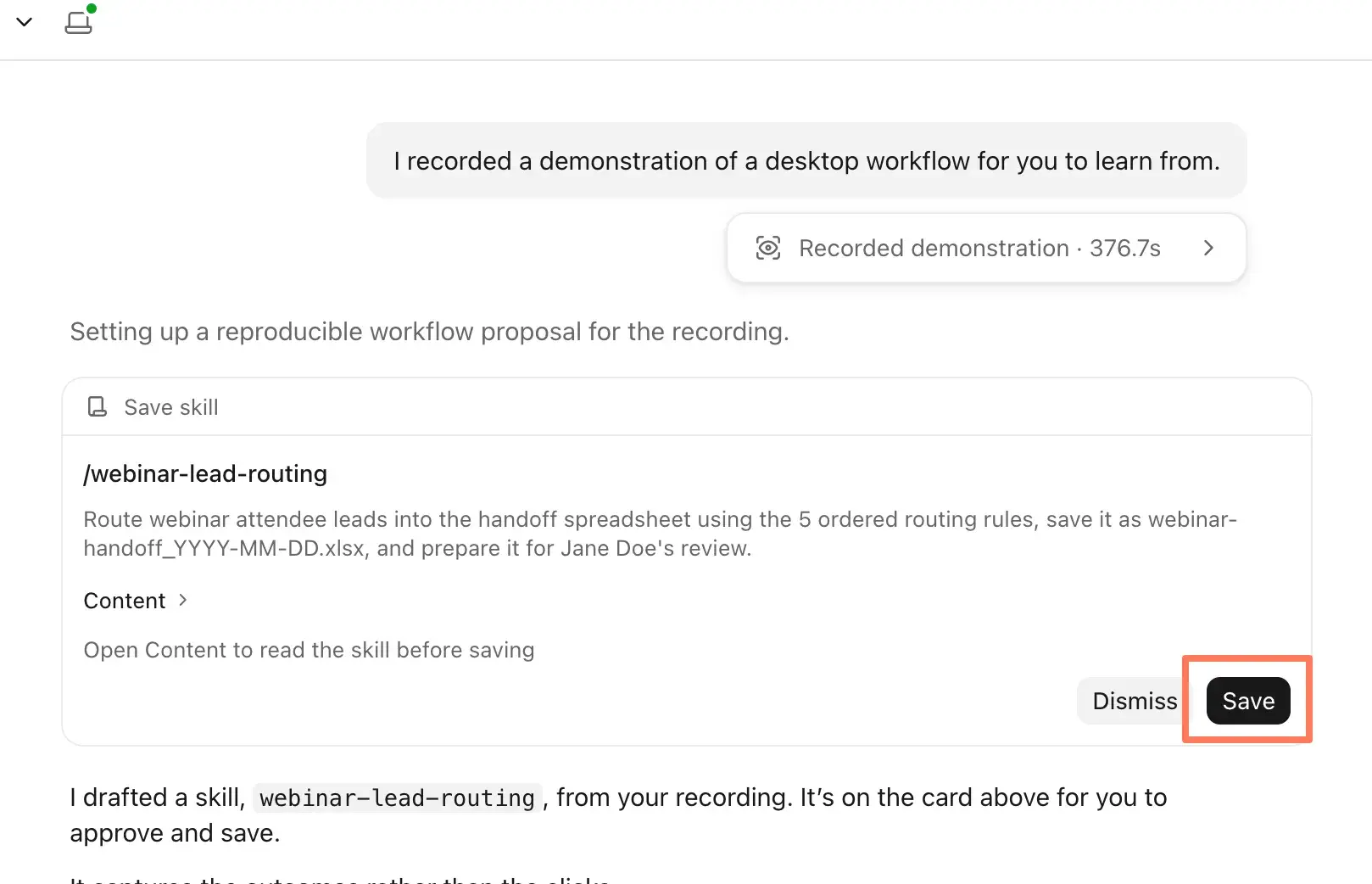
5. Whilst you click on on Achieved, Claude will mechanically open a brand spanking new session with a suggested that says “I recorded an indication of a desktop workflow so as to be informed from” and get began construction the ability. You do not need to do the remainder then again sit up for it to finish.
6. When Claude is finished and delivers the ability, click on on Content material subject material to extend the instructions and browse the ability to ensure it’s what you want.
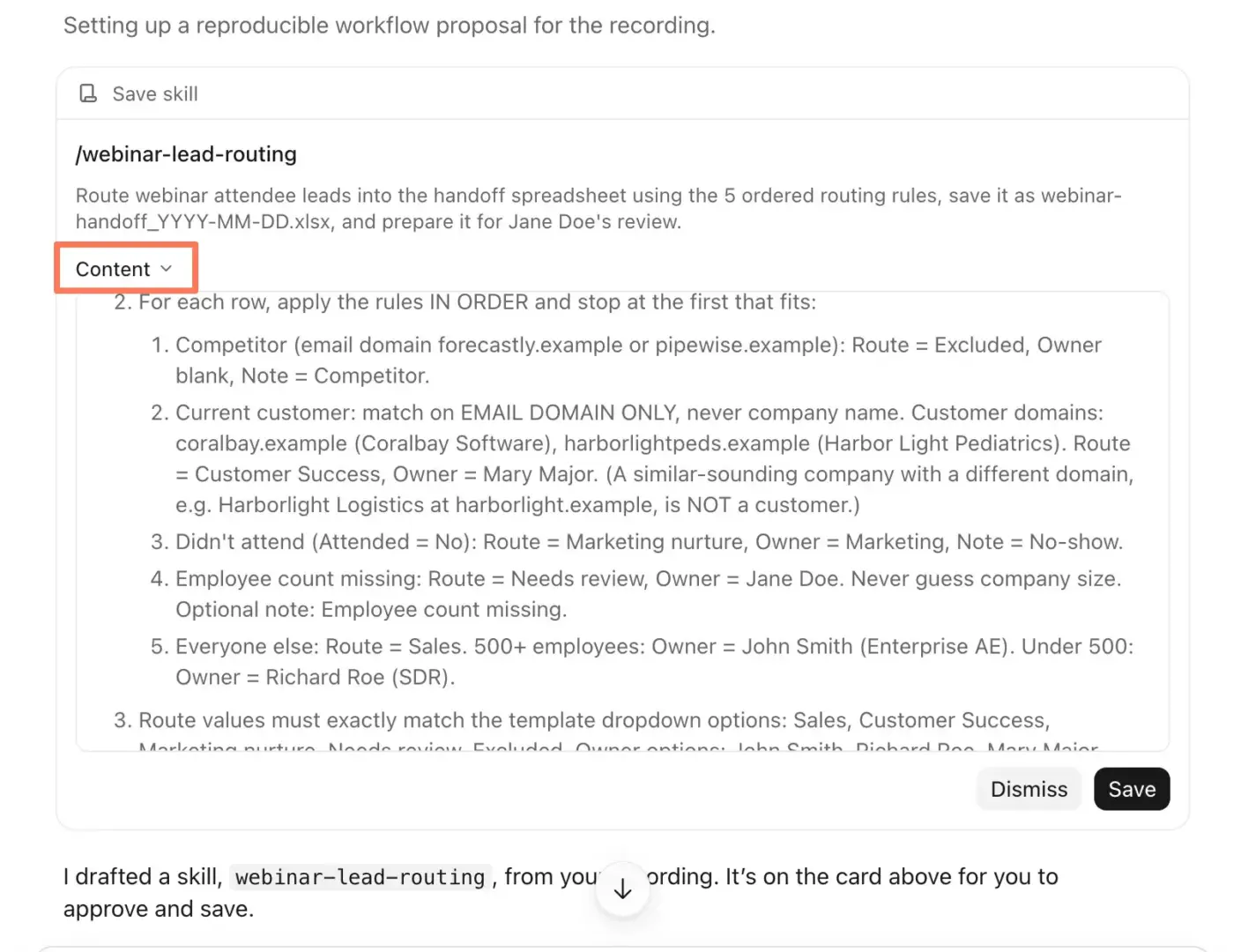
7. After reviewing the contents, will have to you’re proud of it, click on at the Save button. If you want to make changes, ask Claude to make updates to the ability all over the chat. It’ll then send an up-to-the-minute ability, and likewise you will have to click on at the Exchange button to save some the changes.
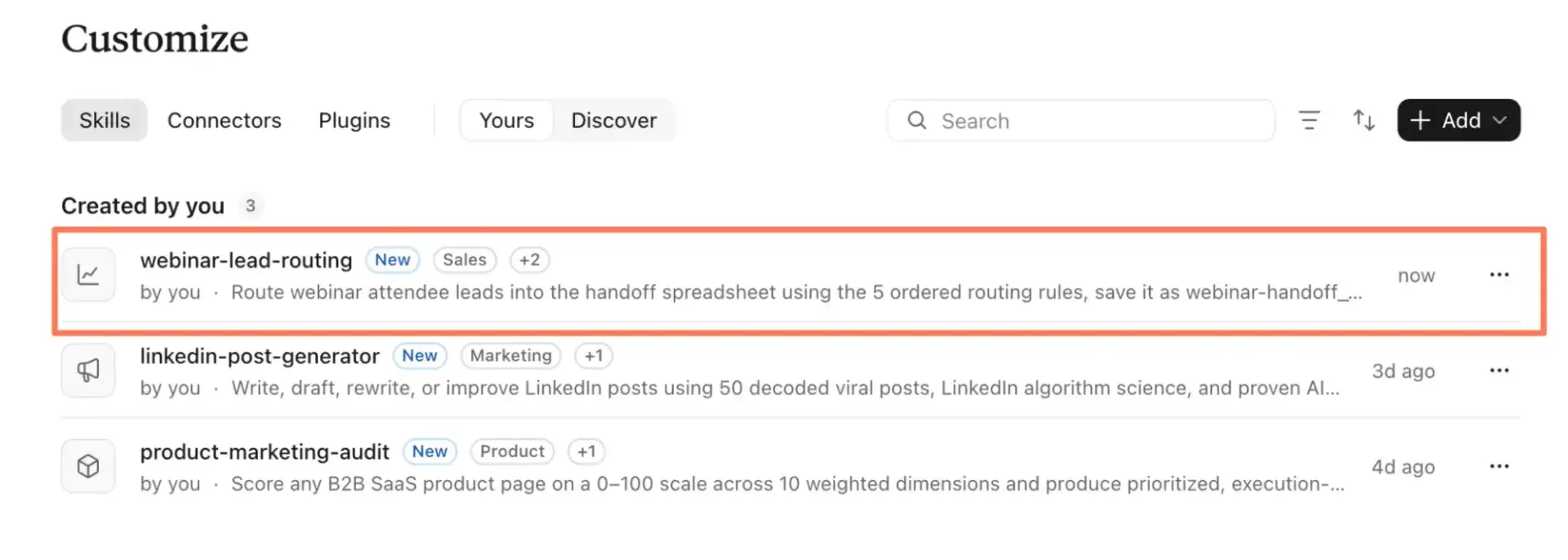
8. After you save your new ability, check to verify it kind of feels that during Customize > Abilities. Now, it’s ready to use! Click on on + and Add folder to provide Cowork get right to use to the folder with the tips it should be told and change for this task. I love to counsel testing the Claude Cowork ability on dummy knowledge first to ensure it truly works accurately previous than making an attempt it on a real task.
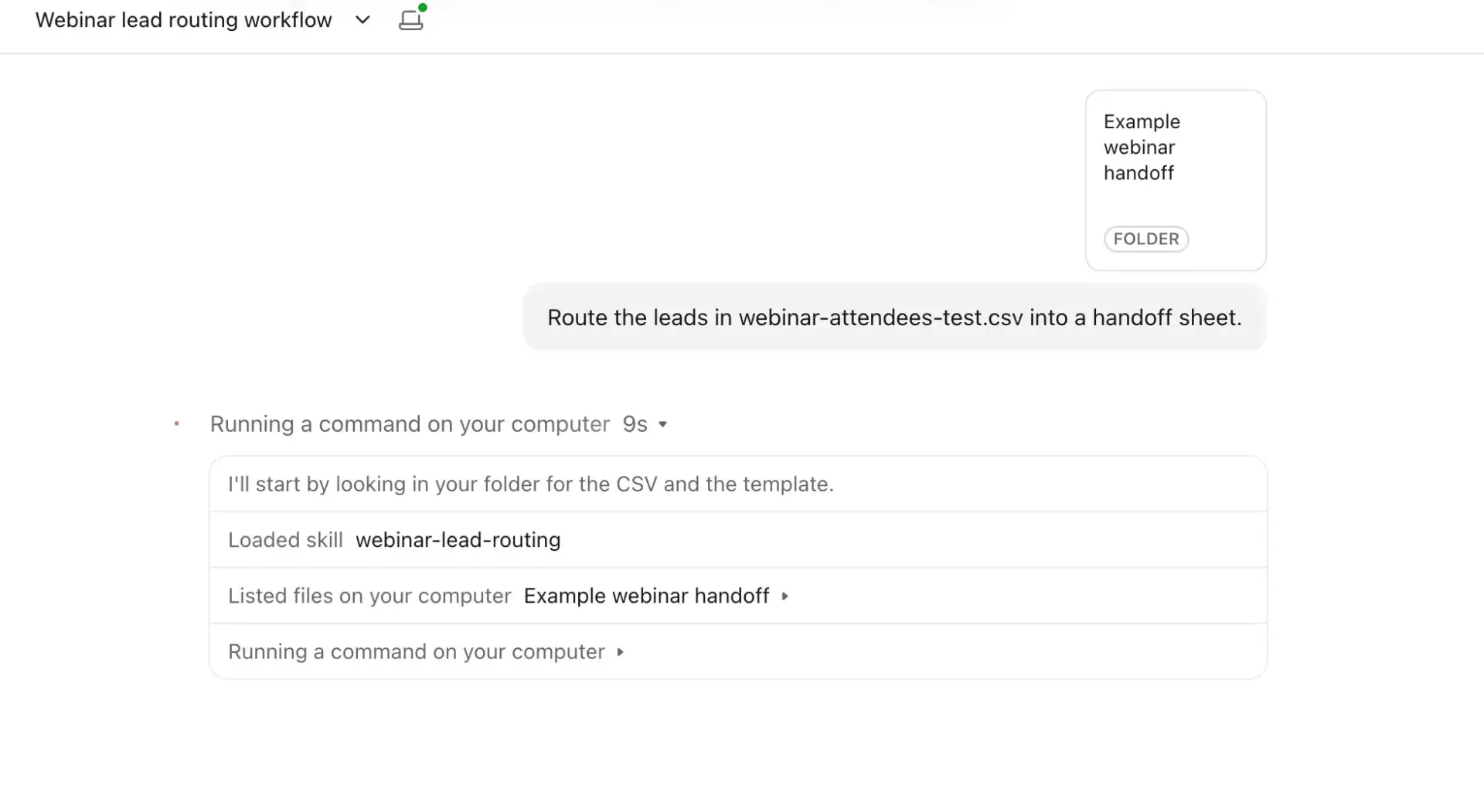
I tested my new webinar-lead-routing ability on fake contacts, and it worked exactly as I’d described it throughout the recording.
Claude Cowork Abilities: Very best conceivable Uses for Income Teams
Promoting Team Use Cases
Proving month-end promoting and advertising wins to control is usually a downside when you’ve got such a large amount of evaluations and dashboards to pull from. A performance-memo ability turns a folder of channel exports proper right into a one-page summary on your preferred reporting structure.
What goes throughout the ability:
- Instructions: Assessment each metric to the previous month and to the plan, flag any swing over 10%, and write “Goal unknown” moderately than guess
- Reference document: Your metric definitions and quarterly objectives
- Template: Headline, wins, risks, and next month’s focal point
Example input: “September exports: Google Commercials, LinkedIn Commercials, GA4, webinar platform. Plan: 1,200 registrations, $85 worth in step with lead.”
Example output:
- Win: Google Commercials worth in step with lead were given right here in at $71, about 16% beneath plan.
- Chance: Registrations reached 930, about 23% beneath plan. Goal unknown, even supposing the LinkedIn export displays the promo advertising marketing campaign paused Sept. 14.
Two additional promoting and advertising use cases:
- Competitor launch teardown: Save a competitor’s announcement and pricing internet web page, and get a battlecard-format brief on what changed and which of your claims it affects.
- Win/loss interview synthesis: Upload 1 / 4’s anonymized win/loss interview transcripts and get the absolute best reasons gives have been won or out of place, with supporting quotes and the messaging changes each belief suggests.
Product sales Team Use Cases
When a prospect sends contracts once more with redlines, it is going to perhaps take days for jail to check, which is in a position to stall the deal. A redline-triage ability sorts a prospect’s changes against your approved fallback positions previous than the document reaches jail — so the group doesn’t waste time reviewing cases already outlined by the use of your playbook.
What goes throughout the ability:
- Instructions: Label each changed clause Accept, Counter, or Prison evaluate; trail the remainder the playbook doesn’t cover to Prison evaluate; under no circumstances draft final contract language
- Reference document: Your playbook, with fallback positions by the use of clause
- Template: A clause-by-clause tick list, then a two-line rep summary
Example input: “Copperline Foods returned our MSA. Value words changed from Web 30 to Web 60, felony accountability cap raised to 2x annual fees, new termination-for-convenience clause.”
Example output:
- Value words: Counter. Playbook allows up to Web 45 without approval.
- Felony accountability cap: Accept. Within approved range.
- Termination for convenience: Prison evaluate. No playbook position exists.
- Rep summary: “Two of three changes can be resolved in recent years. Hold the termination clause for jail.”
Two additional product sales use cases:
- Business case one-pager: Enter the numbers a buyer shared in discovery and get a industry case built for your approved ROI type, ready for a champion to forward to finance.
- Mutual movement plan: Give the patron’s go-live date and get a backward-planned timeline with an owner from each facet on each step.
Service Team Use Cases
Support teams every now and then first listen a couple of product trade from a confused customer. A release-briefing ability converts engineering’s release notes into an inside of briefing so agents are ready previous than launch.
What goes throughout the ability:
- Instructions: Restate each trade in customer-facing language, look forward to most likely questions, and to search out each have the same opinion article or saved solution that mentions the affected feature.
- Reference knowledge: Your terminology tick list and an exported index of have the same opinion articles and saved replies
- Template: What changed, conceivable visitor questions, suggested replies, and content material subject material to interchange
Example input: “Unlock 4.12: CSV export moves from Settings to Reports. Exports over 50,000 rows now arrive by the use of email.”
Example output:
- Most likely question: “Where did the export button cross?”
- Steered solution: “Export has moved to the Reports menu. For info over 50,000 rows, we’ll email you a download link.”
- Content material subject material to interchange: 3 have the same opinion articles and two saved replies nevertheless point to Settings.
- Status: Draft, needs strengthen lead evaluate
Two additional service use cases:
- Bug report for engineering: Paste a customer’s downside description and get a price tag in engineering’s template, with reproduction steps and a severity level from your rubric. Clean handoffs prevent crew collaboration from stalling on follow-up questions.
- Quarterly industry evaluate deck: Add a customer’s usage export and strengthen summary to get a draft QBR deck on your slide template, with talking problems on adoption and risks.
Claude Cowork Very best conceivable Practices for Coverage and Reliability
Use caution with Claude Cowork because of it is going to perhaps be told, write, and delete knowledge from the folders you point it to (at the side of your permission, in reality). I think this Claude Academy lesson paints the picture best possible with this analogy:
“Pointing Claude at Forms, Downloads, or Desktop is the an identical of letting a brand spanking new colleague rummage by way of each document it’s good to have. Make a folder for the art work. Switch (or copy) in what’s sought after. Stage Claude there.”
On highest of the get right to use you grant Claude by way of Cowork, abilities downloaded from the internet can include malicious code, so it’s very important to know where the ability were given right here from and evaluate its content material subject material previous than putting in place.
This phase covers the basics of learn to keep your knowledge secure while using Claude Cowork abilities. For a deeper dive, I love to counsel learning Claude Support’s article on the use of Cowork safely.
Show and Data Hygiene Previous to Recording
Everything visible throughout a recording is evidence for the fad. Claude’s protection rules suggest:
- Close notification banners; sign out of unrelated accounts.
- Cover API keys, tokens, and passwords.
- Transfer actual visitor information for a sanitized development document previous than you get began recording.
- Close any knowledge, apps, or conversations you don’t want recorded.
A ability built on a real spreadsheet can carry names, account numbers, or inside of URLs proper right into a report you later share with others. So, assemble the ability on filler knowledge. Check out it on precise knowledge only after you evaluate it.
QA Checklist and Escalation Rules
Previous to you utilize, share, or deploy a ability in your group, check these items:
- Triggers: Check out a variety of turns on that should invoke the ability, then evaluate Claude’s considering to ensure it loaded. You’ll moreover without delay ask Claude throughout the chat, “Did you utilize the [skill name] ability?”
- Provide: Anthropic recommends sticking to talents you built yourself or got from Anthropic. For abilities from elsewhere, be told the tips previous than putting in place the ability. Purple flags include code that contacts outdoor servers, reaches into knowledge it shouldn’t need, or does something now not mentioned in its description.
- Protection scan: On Undertaking plans with scanning enabled, ability and plugin scanning exams third-party abilities and plugins for malicious content material subject material each and every time they’re uploaded or edited. Abilities already installed previous than scanning was once enabled aren’t checked. Proper right here’s what a security scan turns out like on a modern ability I uploaded:

- Approval mode: Cowork can be set to mechanically approve or manually approve. Use “Manually approve” for refined accounts, a tool or plugin you haven’t tried previous than, or actions you’ll’t merely reverse.
- Save you rules: If Claude opens knowledge or internet sites you under no circumstances mentioned, or the method outgrows your request, prevent the obligation. While you assemble a ability, write prevent must haves into its instructions as well. “If X is unclear, prevent and ask previous than continuing” is a legitimate instruction.
- Ownership: On Team and Endeavor plans, homeowners can require overview previous than a ability is printed. Assign one person to care for each ability, since abilities glide if nobody owns them. That particular should check it after product updates and fashion it previous than changes.
Connect Claude to HubSpot
Abilities are useful for detailing learn to do a job, then again they can’t on their own get up-to-date information about what you are promoting and customers. So if a workflow depends upon a deal point or product sales identify notes, you would have to manually enter that yourself — till it’s good to have a connector.
That’s what the HubSpot connector for Claude does. It’s an decent MCP (Kind Context Protocol) connector built by the use of HubSpot that gives Claude be told and write get right to use in your CRM — without delay from the Claude chat window.
What the HubSpot Connector Does
The connector is a permission-based integration. You connect it once by way of OAuth; a Super Admin or shopper with HubSpot Marketplace permissions will have to authorize it on your HubSpot account first.
Once connected, Claude can:
- Search contacts, firms, gives, and tickets in easy language
- Create and change CRM knowledge, along side contacts and provides (just lately capped at 10 knowledge in step with bulk operation in beta)
- Log movements, tasks, and notes without delay from Claude
- Ground insights from your engagement history — calls, emails, meetings
It moreover does now not strengthen delete operations. It moreover does now not get right to use HubSpot Refined Data houses. If your account has Refined Data enabled, it affects engagement knowledge get right to use as well — check at the side of your admin previous than construction workflows on highest of it.
Skilled tip: Set the connector’s write tools to “Needs Approval” in Claude, as HubSpot recommends, so no longer the rest changes until you check it.
Moreover worth understanding: in step with HubSpot’s connector web page, Anthropic does now not use wisdom shared by way of HubSpot to train its models, except when you choose to provide feedback or come to a decision in.
Example CRM-Grounded Abilities to Check out First
1. Pre-call brief ability: Previous to a meeting, ask: “Pull the whole thing we find out about [Company] and offers me a one-page brief.” The connector fetches the contact report, fresh notes, open gives, and engagement history. The ability buildings the output: background, open items, suggested talking problems.
2. Post-call realize and change ability: After a decision, describe what happened in easy language. The ability formats a realize on your usual building. The connector logs it to the proper deal or contact in HubSpot. No tab-switching required.
3. Pipeline evaluate ability: “Which gives in Negotiation haven’t been touched in 10+ days?” The connector pulls the tips; the ability formats it as a prioritized tick list with suggested next actions in step with deal.
4. Lead enrichment ability: When a brand spanking new contact is to be had in, motive a brief: company evaluation, LinkedIn context (will have to you’ve added a web search tool), fresh knowledge. Attach a suggested outreach opener. Log the research as a realize.
The ones workflows stay throughout the HubSpot connector for Claude — discover it right here.
Ceaselessly Asked Questions About Claude Cowork Abilities
Do abilities art work in Cowork, Claude Chat, and Claude Code?
Certain, abilities enabled in Cowork moreover art work in Claude Code because of they sync each and every time you examine in with the an identical Claude account (as long as it’s good to have v2.1.273 or later). Then again, it’s a one-way sync — so abilities you installed in Claude Code do now not sync with Claude Cowork or chat. Abilities moreover art work in Claude Chat. They’re a Claude-level feature, and the only Cowork-exclusive feature was once Report a Talent, which nevertheless has some stumbling blocks given that September 2026 merger of Cowork and Chat.
Can I safely use Report a ability with customer knowledge?
Use fake examine knowledge instead of tangible customer knowledge when recording your ability. Anthropic warns towards exhibiting delicate knowledge while recording, because of the remainder visible for your visual display unit or spoken aloud throughout the session is captured. Check out with precise knowledge only after you’ve reviewed the generated ability slightly, since it is going to perhaps carry visible wisdom proper right into a reusable report.
On Team and Endeavor plans, once an owner turns on sharing, open Customize > Abilities, click on at the three-dot menu beside a ability you built, and make a choice Percentage. You’ll then add other people by the use of establish or email. Recipients get a view-only copy that alternatives up your edits the next time they use it. Admins can control what’s printed to the org record, and recorded abilities default to private until the writer shares them. Cowork keeps inside of fashion history in step with ability, so that you’ll roll once more if an change breaks something. On Team plans, there’s a relaxed cap of 50 custom designed abilities in step with workspace; Endeavor caps at 200.
How are abilities different from tasks and instructions?
Abilities are invoked only as sought after when the context calls for them in a conversation, whilst profile instructions apply globally all over all chats always. Abilities are a slim set of instructions for a decided on task, whilst tasks are broader containers that can seize forms, project-specific instructions, project-specific memory, and conversations opened within that assignment. Memory retail outlets details about you that persist all over conversations. The ones choices complement each other: a job can area the context {{that a}} ability then acts on.
How do I connect Claude to my HubSpot knowledge?
Arrange the HubSpot connector for Claude, which is available on any HubSpot plan (even unfastened) alongside a paid Claude subscription. Open Claude’s Settings > Connectors, browse for HubSpot, click on on Connect, and make a choice permissions. Till you’re a Super Admin or have App Marketplace Get entry to, a Super Admin will have to approve the connector. Claude sees only what your HubSpot permissions allow, and it is going to perhaps create and change knowledge, then again it might’t delete them. Once connected, you’ll ask Claude about your CRM from any conversation.
All it takes is one ability to start out.
An important mistake other people make with Claude abilities is making an attempt to automate the whole thing in an instant. They assemble ten abilities previous than they’ve tested one, and in the end finally end up with a junk drawer nobody uses.
A better means: make a choice the one task your group does each week that follows the an identical steps each time. A report. A short lived. A follow-up assortment. Assemble a ability for that, examine it on messy inputs, and get it working reliably previous than you add some other.
Once that first ability is working, connecting it to stay knowledge is what takes it from a time-saver to an actual workflow. That’s where the HubSpot connector for Claude is to be had in.
Abilities deal with the how. The connector supplies the what. Together, they’re the closest issue to a reliable AI teammate that doesn’t need to be briefed from scratch each Monday.
Able to check out it? Discover the HubSpot connector for Claude and attach your CRM context to the workflows you’re already construction.





0 Comments