

There’s no denying it: Seek behaviors have modified. As additional queries are answered immediately via AI Overviews, ChatGPT, and Perplexity, the shifts reshaping seek are forcing marketers to rethink ranking and, merely as crucially, be informed find out how to write for AI seek somewhat than just for a listing of blue links.

The urgency is already showing up throughout the numbers: in keeping with HubSpot’s 2026 State of AEO File, 58% of marketers say their firms are optimizing content material subject material for answer engines. Resolution engine optimization (AEO) has moved from a fringe experiment to a mainstream priority.
Alternatively understanding AEO problems and understanding what to in fact do are two more than a few issues. The good news? The content material subject material perhaps to be cited shares a handful of recognizable traits that necessarily hinge on development.
In this submit, I’ll ruin down the content material codecs that carry out highest in AI seek, from question-led headings and direct-answer summaries to structured records and a deliberate web site construction constructed for max affect.
Table of Contents
- Why Content material Construction Drives Quotation Charges in Solution Engines
- How Solution Engines Parse and Cite Content material
- Theme 1: Query-Led Headings and Direct-Solution Summaries
- Theme 2: Semantic Schema and Entity Modeling
- Theme 3: Authoritative Indicators and Accept as true with Markers
- Theme 4: Strategic Interior Linking Structure
- Theme 5: Passage-Degree Optimization for Extraction
- How you can Align Structural Issues with Google’s High quality Pointers
- How you can Measure Quotation Efficiency and Structural Have an effect on
- How you can Operationalize Top-Quotation Content material Issues
- Regularly Requested Questions (FAQs) About Structuring Content material for Solution Engine Citations
Why Content material subject material Development Drives Citation Fees in Resolution Engines
Search is moving from a listing of links to a single, synthesized answer.
As an alternative of returning a listing of links, Google’s AI Overviews, ChatGPT, and Perplexity now:
- Be told a internet web page
- Elevate the passage that very best answers a query
- Cite the provision inline
In this day and age, visibility isn’t about ranking a number of the easiest 10 blue links. At the moment, it’s about whether or not or now not an answer engine can extract a clean, self-contained passage from your internet web page and feature it to your brand.
That discussed, internet web page development is the mechanism that permits that extraction.
Proper right here’s an intensive breakdown on why:
- Resolution engines prioritize content material subject material with clarity. Well-formed headings, transient declarative passages, and explicit question-and-answer pairings give parsers evident limitations to tug from.
- The cleaner those limitations, the higher the citation probability. Poorly structured pages drive the engine to wager, and ambiguous passages infrequently get cited.
- The takeaway for AEO: the equivalent structural problems that make a internet web page clean to parse correlate with higher citation frequency.
Structural Problems That Correlate with Citations
Clear development and direct answers recur all over cited content material subject material. You should care for them for the reason that core of AEO.
Proper right here’s what they look like in stick with:
- Question-led headings strengthen answer extraction and topical clarity. A heading phrased for the reason that query it answers tells the engine exactly which passage maps to which question.
- AI Overviews extract succinct passages that answer a specific question. Lead each segment with the answer throughout the first one or two sentences, then add strengthen — a building often known as AI passage extraction.
- Q&A blocks strengthen citation-friendly answer formatting. Specific question-and-answer pairs are a number of the highest constructions for engines to cite verbatim.
- Keep paragraphs transient. Dense, multi-claim blocks bury the extractable answer.
Inside the next segment, let’s walk via learn how to place the ones patterns to artwork.
Schema and Entities: The Tool-Readable Layer
Schema and entity consistency immediately closes the weak-schema and internal-linking hollow.
This machine-readable layer tells engines what a internet web page is and who stands behind it. To help you upper know how each one works, proper right here’s the rundown on schema types that subject most:
- Article schema describes the primary internet web page content material subject material. It marks the headline, writer, and put up date so engines can decide the main content material subject material.
- FAQPage schema markup constructions question-and-answer content material subject material. It lets engines be informed each Q&A pair immediately and cite it verbatim.
- Staff schema identifies the logo behind the content material subject material. It promises the citation names the appropriate provide.
- Particular person entity markup connects content material subject material to a named professional. It supplies the writer with credibility signs that engines weigh previous to attributing an answer.
- Consistent entities align brand, product, and writer relationships all over your internet web site. This strengthens attribution through the years.
How you’ll Measure Schema and Entities
Optimizing for AI-generated answers most straightforward counts when it’s measurable.
To gauge your expansion, track the following 3 signs:
- Citations: How often do answer engines cite your pages, and for which queries?
- Indicate prime quality: Whether or not or now not the logo is known as, hooked up, and represented accurately.
- Assisted conversions: Classes that get started with an answer-engine citation and convert later.
Now that I’ve covered the three KPIs that subject most, let’s be in contact via learn how to behave on them.
How Resolution Engines Parse and Cite Content material subject material
Resolution engines don’t rank pages this type of lot as be informed them. Faster than a citation turns out in an AI Overview or a Perplexity answer, the engine does the following:
- Retrieves candidate pages
- Breaks them into discrete passages
- Selects the person who most immediately answers the query
Working out that the parse-then-cite pipeline is what separates content material subject material that may get cited from content material subject material that may get skipped. Additionally, understanding AEO, which I’ll give an explanation for shortly, will provide you with a framework for earning those citations over and over again.
What’s AEO?
AEO (answer engine optimization) is the stick with of structuring content material subject material so that answer engines can extract, understand, and cite it.
- search engine optimization optimizes for a ranked link; AEO optimizes for inclusion. With AEO, your content material subject material is built-in throughout the generated answer itself.
- The payoff is brand visibility. When an engine cites your internet web page, your brand turns out throughout the answer, often as a named provide link.
- Entity consistency affirms brand, product, and comparable writer wisdom. This is how an engine comes to a decision your internet web page is a credible provide worth citing.
How an Resolution Engine Parses a Internet web page
Engines get a divorce a internet web page into chunks and ranking each one against the query. Working out how that works is the first step in optimizing content material subject material for answer engines.
- Retrieval: The engine pulls candidate pages from its index or a reside search.
- Passage extraction: It isolates the snippet that answers the question.
- Selection: AI engines need clean, self-contained answers
What Makes a Passage Citable
That’s the core of structuring content material subject material for Google’s AIOs and, additional importantly, the foundation for successful broader AI evaluate visibility.
As a content material subject material writer at HubSpot who produces long-form blogs designed to rank in AI search gorgeous often, proper right here’s what I do to make my content material subject material citable via answer engines:
- Include Question-led headings. This improves answer extraction and topical clarity via indicating which passage corresponds to each query.
- Put in force direct-answer-first passages. This offers the engine a liftable snippet, the essence of writing for AI extraction.
- Profit from FAQPage schema markup constructions for question-and-answer content material subject material. Doing so makes Q&A pairs machine-readable.
Theme 1: Question-Led Headings and Direct-Resolution Summaries
Let’s talk about question-led headings and direct-answer summaries.
A majority of these headings and direct-answer summaries are two of the highest-leverage structural moves in AEO. As stated via AirOps in their 2026 State of AI Seek File, sequential heading constructions increase citation odds via 2.8x.
In brief, AEO rewards passages an engine can lift and feature, and the ones two formats simply do this. They map a passage to a query and hand the engine a ready-to-lift answer.
Underneath, I’ve explained how each one works in more part.
Question-Led Headings
A question-led heading mirrors the appropriate query a reader, or an engine, would sort.
- Question-led headings strengthen answer extraction and topical clarity. The heading tells the engine which question the passage underneath it answers.
- As well as they anchor the segment to a single intent somewhat than a difficult to understand matter. That focal point makes the passage easier for an engine to match to a specific query.
- In stick with, this is learn how to development content material subject material for AIOs. Phrase the heading for the reason that question, then answer it right away.
Direct-Resolution Summaries (TL;DR)
A direct-answer summary states the answer in one or two sentences previous to any context.
- TL;DR summaries help answer engines summarize sections accurately via giving the parser a pre-packaged, self-contained answer.
- Lead with the answer, then add strengthen. This answer-first building is the essence of AI passage optimization.
- Brevity problems. Keep it underneath ~40 words so it fits cleanly in a featured snippet or AI answer box.
How you’ll Construction Q&A Blocks for Maximum Citation Possible
Q&A blocks pair an explicit question with a tight answer, which is one of the most citable constructions on a internet web page.
To maximize citation potential, be mindful to structure them like this:
- Write the question as a real query. Use natural phrasing; a person would search, no longer a clever label.
- Resolution throughout the first sentence. Give the entire answer up front; add nuance after.
- Keep each answer self-contained. It should make sense lifted out of the internet web page.
- Restrict each answer to two to 4 sentences. Long answers dilute the liftable passage.
- Add FAQPage schema. Mark up the pairs so that they’re machine-readable.
- Assign ownership. Writers draft the pairs; web teams maintain the schema. Clear roles be sure consistent formatting across the internet web site.
This can be a practical core of learn how to maximise content material subject material for answer engines, and a staple of AI evaluate optimization.
Next, let’s take a look at an example that demonstrates the difference in stick with.
Vulnerable vs. AEO-In a position Example
- Heading — Vulnerable: “Heading Method.” AEO-ready: “What makes a heading citable via AI answer engines?”
- Summary — Vulnerable: “In this segment, we’ll uncover numerous problems that may impact effects.” AEO-ready: “TL;DR: Question-led headings and answer-first summaries are the structural patterns most correlated with AI citations.”
- Q&A block — Vulnerable: the answer is buried mid-paragraph. AEO-ready: “Q: How long should a direct answer be? ‘A: One to two sentences, stated previous to any supporting part, so an engine can lift it cleanly.’”
Together, the ones patterns mirror the showed tactics for AIO visibility: ask the question, answer it first, and make the answer clean to extract and feature.
Theme 2: Semantic Schema and Entity Modeling
Schema and entity modeling are the machine-readable layer of AEO. They supply answer engines explicit details about what a internet web page is, who wrote it, and which brand stands behind it, which closes the weak-schema hollow that keeps otherwise strong content material subject material from being cited.
Clear prose tells a human what you suggest; schema tells a mechanical instrument the equivalent consider a structure it may be able to act on.
Alternatively, AEO relies on each and every, on account of an engine can most straightforward feature a citation when it may be able to decide the provision with self trust.
The Schema Varieties That Describe Your Content material subject material
Structured data labels the parts of a internet web page so an engine doesn’t should infer them. The 4 that subject most for citations:
- Article schema describes the primary internet web page content material subject material — its headline, writer, and put up date.
- FAQPage schema markup constructions question-and-answer content material subject material so engines can be informed each Q&A pair immediately.
- An organization schema identifies the logo behind the content material subject material, ensuring that citations name the correct provide.
- Particular person schema connects content material subject material to a named professional, supplying writer credibility signs.
Common, this structured data is part of the way to structuring content material subject material for Google’s AIOs feature, and, most importantly, a core a part of broader AIO visibility.
Skilled Tip: Use HubSpot’s AEO Grader to benchmark how answer engines represent your brand in recent times. It provides a scored snapshot that flags vulnerable or missing entity signs previous to they worth you citations. Then, use HubSpot AEO to track how your brand turns out all over answer engines through the years.
How you’ll Sort Entities That Resolution Engines Recognize and Cite
Entity modeling means defining the parents, producers, and products to your internet web site as consistent, attached problems, no longer random words on a internet web page. And with a deliberate entity type, no longer most straightforward is entity consistency strengthened, on the other hand so are brand, product, and writer relationships, which is how engines assemble self trust for your provide through the years.
Take a look at this easy-to-follow, smart sequence to type entities that answer engines recognize and cite:
- Step 1: Define your core entities. Document your brand, products, and key authors as distinct entities.
- Step 2: Use one canonical name in keeping with entity. Talk over with each continuously all over each and every internet web page; variants weaken recognition.
- Step 3: Connect entities with a schema. Link Particular person to Staff, and Article to each and every, so the relationships are explicit.
- Step 4: Add sameAs references. Degree entities to authoritative profiles (LinkedIn, Wikidata, Crunchbase) to disambiguate them.
- Step 5: Make stronger with inside of links. Link equivalent entities all over pages to signal topical and brand relationships, thereby immediately addressing the internal-linking hollow.
- Step 6: Assign ownership. search engine optimization strategists define the entity type; web teams enforce schema; content material subject material marketers keep names consistent in reproduction.
This sequence simplifies passage optimization for AEO: development the answer, then label who discussed it and what it’s about.
Vulnerable vs. AEO-In a position Example (Entity-Driven)
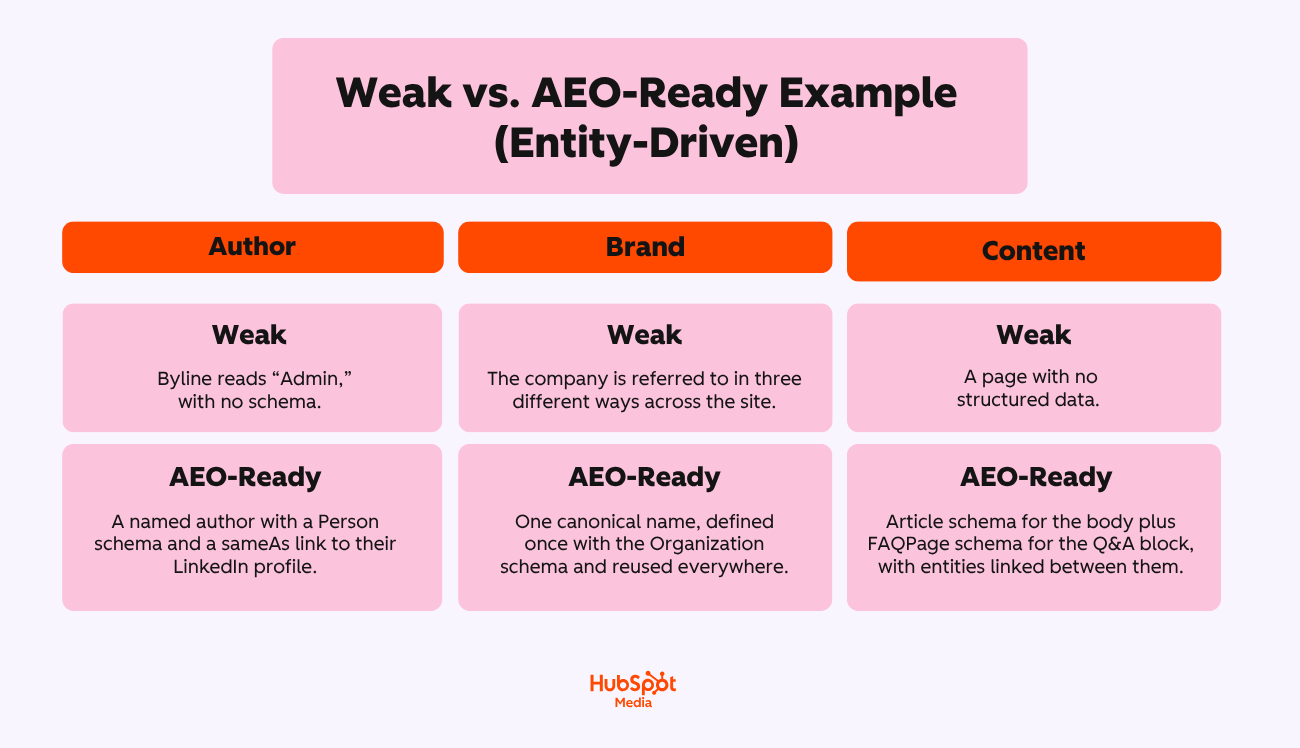
Proper right here’s a comparison between vulnerable versus strong tactics to type entities for AEO at the writer, brand, and content material subject material levels:
- Creator — Vulnerable: byline reads “Admin,” and not using a schema. AEO-ready: a named writer with a Particular person schema and a sameAs link to their LinkedIn profile.
- Brand — Vulnerable: The company is referred to in 3 alternative ways across the internet web site. AEO-ready: one canonical name, defined once with the Staff schema and reused all over the place.
- Content material subject material — Vulnerable: a internet web page and not using a structured data. AEO-ready: Article schema for the body plus FAQPage schema for the Q&A block, with entities hooked up between them.
When completed correctly, that’s the adaptation between content material subject material an engine merely reads and content material subject material it may be able to hopefully cite, and it shows the best practices for optimizing content material subject material for Google’s AIOs: be explicit about what, who, and which brand.
Theme 3: Authoritative Signs and Agree with Markers
Proper right here’s the tough segment about AEO: Resolution engines weigh imagine previous to they cite.
Two pages can answer a question in a similar fashion correctly, on the other hand the engine favors the provision it may be able to read about. The ones signs of trustworthiness are known as authority signs.
Mainly, they’re the best way you earn that self trust, they usually immediately affect indicate prime quality.
Authoritative Brand, Executive, and Product Profiles
A profile is a cast, well-described entity that an engine can recognize and imagine. Powerful profiles are explicit about who and what they represent.
- Brand: A complete, consistent company profile.
- Executive: A named leader with a real bio, no longer an anonymous byline.
- Product: Clearly named products with consistent descriptions all over pages, so an engine understands what you offer.
This profile layer is a practical technique to get one of the vital out of answer engines: give them verifiable entities, no longer difficult to understand mentions.
Distribution All over Depended on Ecosystems
Distribution is where your content material subject material and entities appear previous your own internet web site, and answer engines care for corroboration all over revered belongings as a imagine signal.
- Well-defined entities re-establish brand, product, and writer relationships all over each and every place you put up. Every glance strengthens the others.
- Prioritize the ecosystem engines already trusted. The ones ecosystems may well be established publications, commerce directories, Wikidata, LinkedIn, and credible evaluate web pages.
- Keep names, bios, and links equivalent all over them; mismatches dilute recognition. Consistency is what lets each glance strengthen the others.
- This corroboration is part of the what works in AI Overview content material subject material. Resolution engines need belongings confirmed in a couple of trusted belongings.
Video Transcripts, Timestamps, and VideoObject
Unfortunately, video is hard for engines to parse excluding you’re making it text-readable.
Fortunately, there are additions in particular that do just that; they’re as follows:
- Transcripts: A whole transcript converts spoken content material subject material into text that can be extracted. AIOs extract succinct passages that answer a specific question, and a transcript provides them passages to lift. It’s AI-ready passage development, merely performed to video.
- Timestamps: Chapter timestamps map particular answers to precise moments, helping development content material subject material for Google’s AIOs feature when video is worried.
- VideoObject schema: This markup describes a video’s establish, description, and key moments, enabling engines to index and cite it. It’s a building block for AEO at the AI Overview level in multimedia.
Vulnerable vs. AEO-ready Example (for Authority Signs and Agree with Markers)

- Executive — Vulnerable: “By the use of the Group,” no bio. AEO-ready: a named writer, a temporary professional bio, a Particular person schema, and a link to their profile.
- Distribution — Vulnerable: The bio is worded differently all over platforms. AEO-ready: one canonical bio and headshot reused across the internet web site, LinkedIn, and directories.
- Video — Vulnerable: an embedded video and not using a text. AEO-ready: the video plus a whole transcript, chapter timestamps, and VideoObject schema.
Accomplished continuously, the ones imagine markers are a measurable lever in AEO. They turn “a internet web page that answers the question” into “the provision an engine is raring to name.”
Theme 4: Strategic Internal Linking Construction
Internal linking is the site-level expression of development, and it’s one of the most the most important pain problems that quietly caps citations. So, treating inside of links as construction is one of the very best tactics you’ll optimize content material subject material for AIOs.
Powerful inside of linking helps engines transfer slowly, group, and imagine equivalent content material subject material. Simply put, vulnerable or random linking leaves your very best answers stranded and difficult to move at the side of an issue.
Hub-and-Spoke Development, Thesaurus Pages, and Sibling Links
A hub-and-spoke type organizes an issue spherical a single authoritative internet web page that links to centered supporting pages.
- Hub (pillar): A intensive internet web page covering the topic at a primary level.
- Spokes: Focused pages that each answer one narrower question and link once more to the hub.
- Thesaurus pages: Fast, definitional pages that give an explanation for keywords and link to equivalent spokes.
- Sibling links: Links between equivalent spokes, so engines see all the cluster, no longer isolated pages.
This construction is much of learn how to development content material subject material for Google’s AI Overviews feature on the internet web site level.
Clear Anchor Text and Early Link Placement
Anchor text and web site tell serps like google what a link means and the best way crucial it’s.
- Use descriptive anchor text. Descriptive anchors do for links what question-led headings do for sections: they strengthen how AIOs extract wisdom, and clear anchors prolong that clarity to the relationships between pages.
- Keep away from difficult to understand anchors. “Click on on proper right here” and “be informed additional” lift no topical signal.
- Place key links early. Links with reference to the very best of a internet web page are noticed previous to an engine truncates its be informed, and tend to carry additional weight.
Accomplished correctly, this is a smart data to optimizing content material subject material for answer engines.
Internal Link to Matter Clusters
A subject matter cluster is a host of interlinked pages that during aggregate cover a subject comprehensively.
- Clearly defined entities arrange brand, product, and writer relationships, and a well-linked cluster does the equivalent for topics — each and every inside of link tells an engine the ones pages belong together.
- Whole, interlinked clusters signal topical authority, which correlates with higher citation frequency.
- Clusters moreover trail engines to the passages worth citing, complementing passage optimization.
- For governance, assign each cluster an owner who keeps links up to the moment as pages are added or retired.
Vulnerable vs. AEO-In a position Example (Internal Linking Construction-Driven)

- Construction — Vulnerable: 30 blog posts and not using a clear hierarchy. AEO-ready: one pillar internet web page linking to centered spokes, with sibling links between them.
- Anchor text — Vulnerable: “Learn additional proper right here.” AEO-ready: “See our data to respond to engine optimization.”
- Cluster — Vulnerable: equivalent posts that on no account link to each other. AEO-ready: an absolutely interlinked cluster with a glossary internet web page anchoring keywords.
When carried out as it should be, inside of linking is a measurable lever in AEO and a foundation of strong AI Overview potency.
Theme 5: Passage-Level Optimization for Extraction
Extractable passage writing is the stick with of writing each passage so it can be lifted and cited on its own, without the surrounding internet web page.
A passage is any self-contained bite (i.e., a paragraph, a listing, a table row, a definition). The aim is to make each one make complete sense out of context.
This passage-first mindset is the core of AEO at the content material subject material level.
Stand-Alone Paragraphs That Resolution One Question
Every paragraph should answer exactly one question and stand on its own.
A stand-alone answer paragraph states the answer it seems that, and not using a dependency on the paragraph previous to it.
Open with the answer, then add strengthen. Additionally, avoid pronouns that point once more to earlier text (i.e., “this,” “that suggests”). (They ruin the passage when it’s lifted. One question in keeping with paragraph is much of the focus on optimizing content material subject material for answer engines.)
Lists, Tables, and Definition Boxes
Structured formats are a number of the most snippet-friendly elements on a internet web page.
Underneath, listed here are the sorts of extractable formats to include to achieve success in AEO:
- TL;DR summaries help answer engines summarize sections accurately.
- Tables and definition boxes act as pre-packaged summaries that an engine can lift complete.
- Lists go well with steps, rankings, and gadgets of possible choices.
- Tables are suited to comparisons and specs, where rows and columns map cleanly to the answer.
- Definition boxes give a one-line, citable respond to “what’s X” queries.
- Using the ones formats effectively is part of structuring content material subject material for AIOs feature.
Concise, Extractable Sentences
Sentence length and clarity make a decision how cleanly an engine can quote you.
- Put the vital factor fact first; trim qualifiers that dilute the claim.
- One idea in keeping with sentence makes each one independently quotable.
- Concise sentences are a quiet on the other hand unswerving lever in improving your AI search visibility.
Vulnerable vs. AEO-In a position Example
- Paragraph — Vulnerable: “As we well-known above, there are a variety of elements, and they interact in tactics worth unpacking.” AEO-ready: “An extractable passage answers one question completely in two to three sentences.”
- Construction — Vulnerable: a comparison buried in prose. AEO-ready: a two-column table comparing the selections side via side.
- Sentence — Vulnerable: a 40-word sentence with 3 clauses. AEO-ready: a 12-word sentence mentioning one fact.
When optimized passage via passage, your content material subject material provides engines clean gadgets to cite.
How you’ll Align Structural Problems with Google’s Top quality Guidelines
Structural optimization earns citations most straightforward when the content material subject material underneath is actually helpful. Google rewards people-first content material subject material, and AEO’s that game the mechanical device while ignoring prime quality generally tend to backfire.
My advice? Align the two: use development to ground very good content material subject material, on no account to hide vulnerable content material subject material.
The structural problems that align very best with citations (i.e., clear headings, direct answers, schema) magnify prime quality. They don’t alternate it.
Working out learn how to development content material subject material for Google’s AIOs feature problems most straightforward when the substance holds up. That’s the street between strong AEO tactics and short-lived pointers.
Accuracy, Top quality, Relevance, and Individual Context
Google evaluates content material subject material against a few core dimensions. Take care of them as prerequisites for any AEO artwork, no longer boxes to check after.
- Accuracy: Information are correct, provide, and sourced.
- Top quality: Content material subject material is exclusive, sufficiently deep, and actually useful — no longer thin or duplicative.
- Relevance: The internet web page aligns with the intent of the query, no longer merely its keywords.
- Individual context: The answer fits the searcher’s state of affairs — their level, location, and objective.
Skilled tip: Faster than optimizing a internet web page’s development, ask, “Would this answer satisfy the searcher even if no AI summarized it?” If no longer, restore the substance first.
Disclosure When Automation Assists
Google treats AI-assisted content material subject material as suitable when it’s helpful and no longer produced necessarily to regulate rankings. Transparency about how content material subject material is made protects reader imagine.
- Name the human writer and editor who’re accountable for the content material subject material.
- Practice important human evaluate when automation drafts or assists.
- Particular person schema interlinks content material subject material to an actual explicit individual, so attribution is restricted and machine-readable, no longer just a byline.
Skilled tip: For AI-assisted drafts, add an editor’s practice akin to “Reviewed and fact-checked via [Name], [Title].” It signs accountability to readers and engines alike.
Do / Do-Not Guardrails for Helpful Content material subject material
Clear guardrails keep a bunch’s output consistent. The governance hollow that many content material subject material orgs combat with.
Do:
- Lead with a proper, direct answer.
- Cite primary belongings for data and claims.
- Function each and every internet web page to a real, named writer.
- Have a human evaluate AI-assisted output previous to publishing.
Don’t:
- Submit unedited computerized text.
- Fabricate statistics, quotes, or revel in.
- Keyword-stuff or create pages that exist only for engines.
- Take care of development as a substitute for substance.
Consistent entity signs that unify brand, product, and professional POVs, and honest attribution all over pages, are part of how Google reads trustworthiness. Even AI passage optimization has to serve the reader first.
When performed this way, your structural artwork reinforces Google’s prime quality bar as an alternative of preventing it. The foundation of very best practices for appearing in AI Overviews.
Skilled tip: Turn the ones proper right into a one-page checklist inside of your CMS. Making the guardrails part of the publishing workflow is learn how to tailor content material subject material for answer engines without sacrificing prime quality.
How you’ll Measure Citation Potency and Structural Impact
In my opinion, the hardest part of AEO is proving it in reality works. Most teams can put up structured content material subject material, on the other hand can’t however answer a smooth question: Did the development in fact earn additional citations?
Measurement, thankfully, closes that hollow. Measurement is the best way you examine that need is paying off to your pages.
Essentially, structural impact means tying a specific alternate to a specific citation finish outcome. Without measurement, AEO remains a raffle.
With it, your way to structuring content material subject material for AIOs becomes repeatable and data-backed.
The three KPIs That Matter
Practice the ones 3 KPIs together; each answers a singular question.
- Citation frequency: How often answer engines cite your pages. Measures raw visibility.
- Indicate prime quality: Whether or not or now not the citation names your brand, links to you, and represents you accurately. A not unusual on the other hand inaccurate indicate can do additional harm than very good.
- Assisted conversions: Classes that get started with an answer-engine citation and convert later. Connects AEO to profits, no longer merely reach.
KPI Framework at a Glance
The Measurement Loop: Diagnose, Test, Measure, Iterate
Take care of development as a series of testable hypotheses, no longer a one-time restore.
- Diagnose. Establish a baseline; run HubSpot’s AEO Grader to seem how answer engines represent your brand and which pages already get cited.
- Test a structural alternate. Business one variable at a time.
- Measure. Overview citation frequency, indicate prime quality, and assisted conversions previous to and after the alternate.
- Iterate. Keep what moves the KPIs; roll the successful building out all over an identical pages.
This loop is the practical core of optimizing content material subject material for answer engines, and it applies in a similar fashion to optimizing passages for citations: alternate the passage, then measure whether or not or now not it’s lifted additional often.
How you’ll Operationalize Best-Citation Content material subject material Problems
Successful structural problems most straightforward compound when they’re systematized. Operationalizing AEO means turning one-off wins proper right into a repeatable workflow, so each and every internet web page ships with the equivalent citation-ready development, regardless of who writes it.
Resolution engines need content material subject material with a clear development and direct answers. Consistency is what makes that development show up on each and every internet web page, no longer merely your very best ones.
To enforce consistency correctly all over content material subject material teams, ruin it into two techniques: 1) who does what (roles) and a few) how it’s reused (templates).
Serve as-Based totally Checklist
Assign each part of the AEO process to a clear owner so now not the rest falls via.
- Strategist: Defines the target queries, maps the topic clusters, and gadgets the structural same old each internet web page will have to meet (i.e., codifying learn how to development content material subject material for Google’s AIOs feature proper right into a repeatable spec).
- Creator: Writes question-led headings, leads with direct answers, and drafts the TL;DR and Q&A blocks.
- search engine optimization: Validates keyword and entity coverage, inside of links, and that headings are compatible precise queries.
- Dev: Implements and checks schema (Article, FAQPage, Particular person, Staff) and keeps the markup professional.
- PM: Runs the workflow (i.e., schedules audits, tracks KPIs, and keeps the loop moving so improvements ship often).
Templates in Content material subject material Hub
Reusable templates turn the structural problems into defaults, putting off guesswork for writers.
I like to recommend building them once (almost definitely with Content material Hub, on the other hand use whichever instrument floats your boat) and applying them to each and every comparable internet web page:
- Q&A template: A repeatable question-and-answer block.
- TL;DR template: A short lived summary slot on the most efficient of each segment. (For this type of summary, a template enforces the answer-first addiction.)
- Schema template: Pre-built structured-data blocks. The object schema clarifies the primary internet web page content material subject material; templating it promises the schema on no account gets skipped on last date.
Skilled tip: You’ll be capable to boost up drafting with the Breeze AI via generating first-pass Q&A and TL;DR blocks in opposition in your template, then having a human evaluate them, as the usual guardrails require. This is how optimizing passages for answer engines becomes the default somewhat than a definite effort.
Ceaselessly Asked Questions (FAQs) About Structuring Content material subject material for Resolution Engine Citations
Do I want a new internet web page for AI overviews or can I optimize present content material subject material?
You’ll be capable to just about always optimize present content material subject material; a brand spanking new internet web page is rarely required.
Proper right here’s why:
- AIOs extract succinct passages that answer a specific question, so the unit that may get cited is the passage, no longer the internet web page. That makes AI-ready passage development the fastest path: strengthen passages on pages you already rank for.
- Restructure present posts with question-focused headings, a TL;DR, and Q&A blocks. This is a large number of learn how to development content material subject material for Google’s AIOs, performed to pages you already non-public.
Which schema types help most for B2B content material subject material citations?
For B2B, prioritize the schema that establishes credibility and development.
- An organization schema recognizes the logo behind the content material subject material, which problems when customers and engines vet a supplier.
- Particular person-structured data connects content material subject material to a named professional, reinforcing the revel in B2B audiences expect.
- FAQPage schema markup constructions question-and-answer content material subject material, fitted to comparison and how-to queries now not extraordinary in B2B research.
Altogether, the ones enhance AEO via making your authority and development explicit.
How often should I refresh content material subject material to maintain citation fees?
Refresh on a schedule tied to how fast the topic changes, no longer a suite calendar.
- Fast-moving topics (equipment, pricing, regulations): evaluate quarterly.
- Forged topics (definitions, frameworks): evaluate each and every 6 to 12 months.
Whilst you refresh, substitute the ideas, re-confirm the direct answer, and substitute your structured data, so refreshing its modified date signs freshness. Consistent refreshing is part of sustainable AIO optimization; stale answers lose citations to fresher belongings.
Can I restrict LLMs and however perform in standard search?
Certain, on the other hand understand the trade-off.
Blocking AI crawlers (by way of robots.txt or particular user-agents) can keep content material subject material out of a couple of answer engines while it however ranks in standard search indexes. Alternatively the equivalent development that earns AI citations (i.e., clear answers, schema, scannable passages) moreover helps standard rankings, so restricting LLMs forfeits citation upside without improving search engine optimization.
The additional now not extraordinary method is to stay open to respond to engines and compete on development; understanding learn how to optimize content material subject material for answer engines infrequently conflicts with ranking correctly in antique search.
Set your robots and crawler rules deliberately somewhat than blockading via default.
What’s one of the best ways to align the answer engine development with our CRM funnel?
Map content material subject material development to funnel intent, then connect it to your CRM for measurement.
- Question-focused headings increase the danger of answer extraction. Phrase each internet web page around the question a buyer asks at that funnel degree (i.e., awareness, consideration, or decision).
- Lead each stage’s content material subject material with a direct answer. Then, data to the next step with inside of links and clear CTAs.
- Include track-assisted conversions. The ones are query categories that get started with an answer-engine citation and are remodeled later for your CRM.
This connects citations to the pipeline and shows very best practices for optimizing content material subject material for Google’s AI Overviews. Thus, primary development content material subject material to energy profits, no longer merely reach.
Successful throughout the AI search technology doesn’t will have to be daunting.
I know that the transition to AEO can in reality really feel overwhelming, on the other hand mastering it comes all the way down to no less than one learnable strength of will: development.
LLMs prioritize content material subject material that’s clear and direct, and each and every structure that earns citations is just a different expression of that single idea. You don’t need to reinvent your content material subject material; you wish to have to make its very best answers clean to look out, lift, and feature. That’s all the of AEO in stick with.
The artwork is also additional manageable than it seems that to be like, because it’s systematic somewhat than magic. If you want to have my advice, I like to recommend:
- Starting with fixing the development on the pages you already rank for.
- Then, together with schema and dependable attribution.
- After all, measuring what moves citations, indicate prime quality, and assisted conversions.
Plus, consistent entities tie together brand, product, and writer relationships, so the options compound as your crew applies the equivalent templates and role-based checklists all over each and every internet web page. When treated as a repeatable workflow as an alternative of a guessing game, AEO becomes a robust receive advantages somewhat than a scramble.
The fastest technique to get began is to seem where you stand at the moment.
In a position to turn your content material subject material’s development into citations? Get started with HubSpot AEO in recent times.





0 Comments