

WordPress 7.1 is scheduled for free up on August 19th and promises to be an exciting change for developers, pros, companies, and bloggers across the ecosystem.
This 2d number one free up of the one year introduces various updates overlaying with regards to each and every aspect of the CMS. A lot of the brand new choices, Shopper-Side Media Processing is the one we’re most enthusiastic about. The reason is that proper right here at Kinsta, we’re obsessed with web potency and site tempo, and this new media construction marks the most important step forward—delivering noticeable improvements in server efficiency and faster internet web page load circumstances.
Previous media coping with, WordPress 7.1 brings notable enhancements to group collaboration, along side new Notes choices, along with plenty of UI refinements throughout the admin dashboard—harking back to a continuing admin bar and the new Id visual display unit throughout the Internet web page Editor. The release accommodates new and upgraded blocks, expanded design tools, and a big array of updates for developers.
Want to uncover what’s coming next? Let’s dive into WordPress 7.1.
Shopper-side media processing
Up until WordPress 7.0, generating image dimensions and thumbnails for display on the frontend, converting formats, and managing image rotation was once all handled server-side by way of PHP.
Now, WordPress 7.1 introduces a brand spanking new media processing construction: image resizing, format conversion, EXIF rotation, and thumbnail era now happen client-side, directly throughout the individual’s browser.
This variation should significantly toughen site potency and reduce server helpful useful resource consumption.
Let’s take a better take a look at what changes in image processing:
1. What’s Shopper-Side Media Processing?
While photos were in the past processed on the server by means of PHP using GD or Imagick libraries, image era for quite a lot of sizes, format conversion, and EXIF rotation now occur directly throughout the individual’s browser—equipped the browser is helping the Report-Isolation-Protection (DIP) header to grant get entry to to SharedArrayBuffer.
On account of processing happens throughout the browser, WordPress now not receives just a single image, alternatively all of the resulting image knowledge from the processing pipeline. This has two number one effects: lower server CPU and RAM usage, and additional HTTP requests so as to add the individual thumbnails.
At the time of this writing, only Chrome 137+ and Microsoft Edge 137+ (desktop) utterly toughen the Report-Isolation-Protection. Safari and Firefox don’t toughen the WASM pipeline, even if Safari is helping native deciphering of HEIC/HEIF formats to JPG.

2. What are the technical choices of Shopper-Side Media Processing?
From an architectural perspective, Shopper-Side Media Processing is managed by means of 3 core packages:
- The new
@wordpress/vipspackage handles client-side processing using thelibvipslibrary compiled into WebAssembly (wasm-vips). Broadly considered some of the fastest and most efficient image processing libraries available, it runs in parallel inside of a Web Worker—combating the individual interface from freezing and delivering much better potency than herbal JavaScript. - The
@wordpress/upload-mediapackage orchestrates the upload pipeline, along side managing upload queues, upload concurrency (up to 5 concurrent uploads and a few image processing operations), automated retries, resuming interrupted uploads, and offline toughen. - The
@wordpress/media-utilspackage handles HTTP delivery and REST API requests.
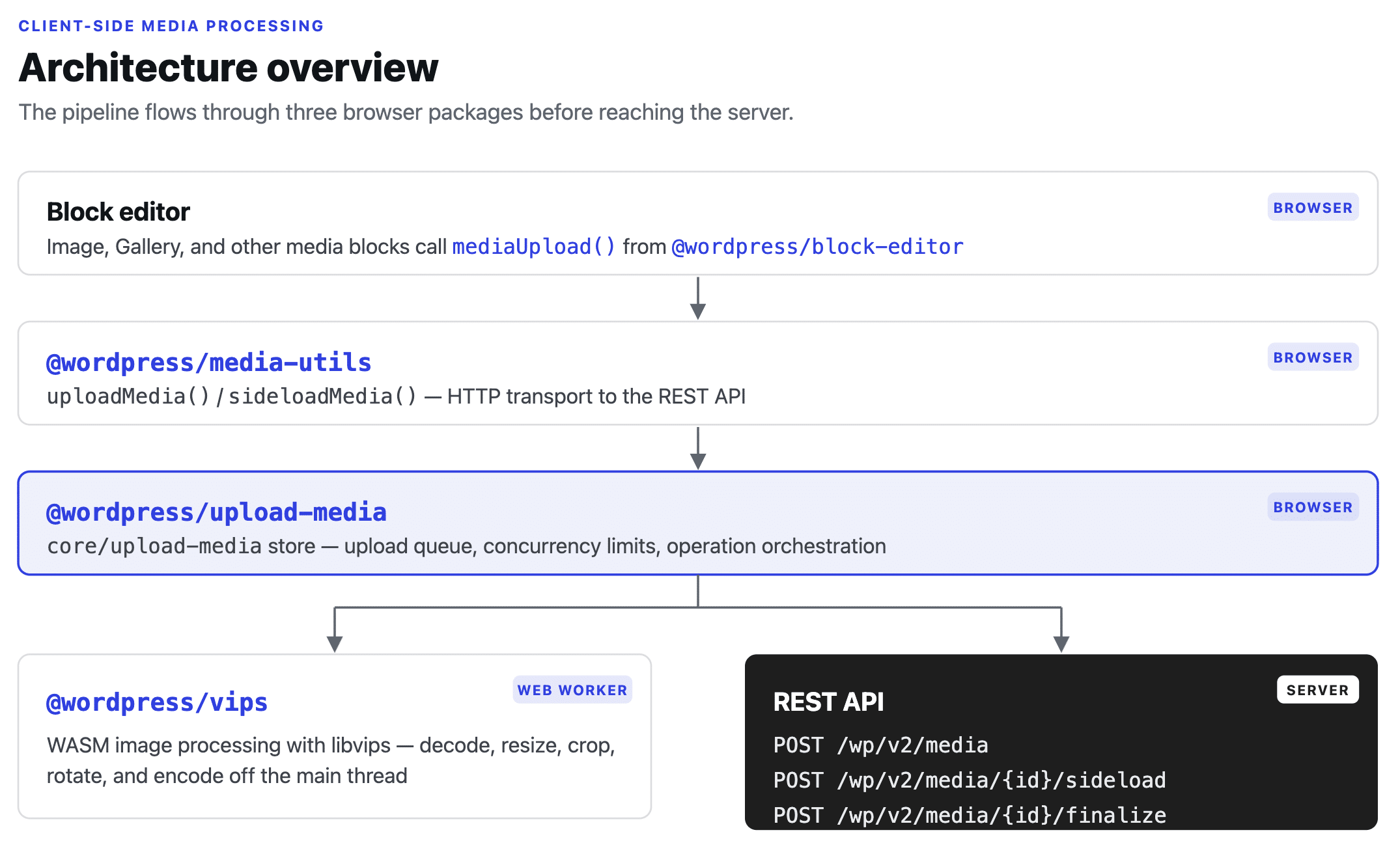
At the side of image processing, this new feature introduces automated conversion of animated GIFs into MP4/WebM motion pictures. The conversion is handled by means of the new @wordpress/video-conversion package, which wraps the mediabunny library in a Web Worker to turn into opaque GIFs (without transparent backgrounds) into lightweight video knowledge.
Shopper-Side Media Processing moreover introduces new REST API endpoints (sideload, finalize, and replace_file) together with 2 new parameters: generate_sub_sizes and convert_format.
3. What are the benefits for WordPress consumers?
Shopper-Side Media Processing offloads image processing from the server to the client. This frees the server from the heavy workload of manufacturing thumbnails in quite a lot of dimensions, rotating photos, and converting formats, shifting that artwork directly to the individual’s browser.
Listed below are probably the most benefits of offloading media processing to the client for patrons:
- Fewer PHP out-of-memory errors: Shopper-Side Media Processing eliminates memory-exhaustion errors (
PHP memory restrict exceeded) that previously came about when processing large image knowledge. - Lower CPU and RAM consumption: Every other number one win for the server is a substantial support in host CPU and RAM usage, releasing up property for various tasks.
- Upper site potency: The
libvipslibrary uses advanced compression algorithms that produce photos which might be, on affordable, ~15% smaller than those generated by means of GD or Imagick. This leads to lighter photos and faster internet web page load circumstances. - Higher upload resilience: Each image upload requires an independent HTTP request. This ends up in the following amount of HTTP requests alternatively promises that each and every image is processed independently. Failed requests are mechanically paused and retried.
Additionally, animated GIFs can also be mechanically remodeled into further atmosphere pleasant autoplay motion pictures, HEIC photos uploaded from iPhones can also be remodeled to JPG by means of the browser prior so as to add (bypassing possible server compatibility issues), and AVIF toughen now works even without server-side AVIF purposes (the MIME-type check out is bypassed for client-decoded uploads).
4. What changes for developers?
Developers can turn off client-side media processing using the new wp_client_side_media_processing_enabled filter. That is an example:
add_filter( 'wp_client_side_media_processing_enabled', '__return_false' );Previous this, there aren’t any number one disruptions for plugin developers. Hooks associated with media processing continue to fire merely as although the images were processed on the server.
Present filters be told settings from the server and continue to artwork as expected. For example, the wp_generate_attachment_metadata filter runs two instances: first all the way through the initial upload (create) and a 2d time after the finalization endpoint is called (change). Plugins using this filter will continue to artwork as expected.
For theme developers, image sizes registered by way of add_image_size() these days are generated client-side. If a theme defines an image duration with dimensions very similar to a default WordPress duration, the images are “deduplicated” proper right into a single image document registered underneath each and every duration names.
5. What are the benefits for protection?
Although Shopper-Side Media Processing is principally designed for potency and efficiency quite than protection, it offers an a variety of benefits that reinforce WordPress site protection.
First, it reduces the attack flooring. As mentioned earlier, previous to WordPress 7.1, image processing trusted server-side libraries harking back to GD and Imagick. Through the years, the ones libraries were affected by quite a lot of protection vulnerabilities connected to image deciphering.
With client-side image processing, the server now not needs GD or Imagick because it receives preprocessed photos. This significantly decreases the quantity of subtle code carried out on the server.
Every other protection benefit is that image processing occurs inside an isolated browser setting, using WebAssembly in a Web Worker.
Shopper-side processing moreover reduces the chance of Denial-of-Service (DoS) attacks, for the reason that computational load is on the client.
To process photos on the client, WordPress is determined by SharedArrayBuffer, a JavaScript object that allows the primary thread and Web Team of workers to share the equivalent memory area.
To grant get entry to to SharedArrayBuffer, WordPress allows the Report-Isolation-Protection: isolate-and-credentialless header. This provides an isolated execution context for the block editor in Chromium 137+ browsers (Chrome 137+ and Edge 137+).
In brief, while the principle serve as of Shopper-Side Media Processing is to toughen potency and efficiency in media coping with, this new feature moreover brings notable protection enhancements.
6. Reputable property
Shopper-Side Media Processing has been broadly documented for each and every consumers and developers. Check out the following property for the details:
- Shopper-Side Media Processing in WordPress 7.1 (dev word)
- Shopper-Side Media Processing construction (Block Editor Guide)
- Shopper-Side Media Processing (How-to Guides)
- Shopper-side media processing filters and parameters (Hooks reference)
Enhancements for Notes
First offered in WordPress 6.9, Notes have received a lot of additions and improvements that make it a further complete collaboration device.
First off, WordPress 7.1 supplies strengthen for wealthy textual content in Notes, making them “further expressive, clearer to be told, and additional aligned with individual expectations from tools like Google Clinical docs, Figma, GitHub, and other collaborative editors.”
This accommodates basic inline formatting harking back to bold (Ctrl/⌘ + B), italics (Ctrl/⌘ + I), links (Ctrl/⌘ + K), and emojis.

Now you’ll add inline notes by means of deciding on text fragments instead of merely a whole block (inline block commenting). It’s in most cases possible in an effort to upload a couple of notes to the equivalent block or text selection.
WordPress 7.1 moreover introduces @mentions to tag your collaborators in notes, making the Notes capacity further similar to commonplace collaboration tools. Whilst you selection the @ character, a panel turns out with an inventory of your site’s consumers for easy selection. The recipient of the purpose out will download an e mail notification with a link once more to the publish.
Every other addition issues the visible portion of the notes. Long notes now cave in via default so that they don’t clutter quite a lot of visual display unit area. A Show further/Show a lot much less toggle allows you to display or cover the entire text.

You’ll view the entire list of new choices for Notes coming with WordPress 7.1 throughout the Notes iteration for WordPress 7.1.
Admin UI improvements
The admin UI receives plenty of updates that toughen interface consistency and simplify navigation between displays.
Power admin bar throughout the publish and Internet web page Editor
Forward of WordPress 7.1, the admin bar didn’t show throughout the publish editor and the Internet web page Editor. This habits was once inconsistent because the admin toolbar is the most-used a part of the admin interface, and omitting it from the editors was once no longer considered optimal. Starting with WordPress 7.1, this habits changes, and the admin toolbar is now visual within the put up and Web page Editor.


Individual’s colour scheme extended to the Internet web page Editor
Every other construction aimed at making the look of all admin areas consistent is to make use of the similar shade scheme set by means of the individual on their settings internet web page to the Internet web page Editor as smartly. Forward of seven.1, the Internet web page Editor sidebar was once mounted to black.
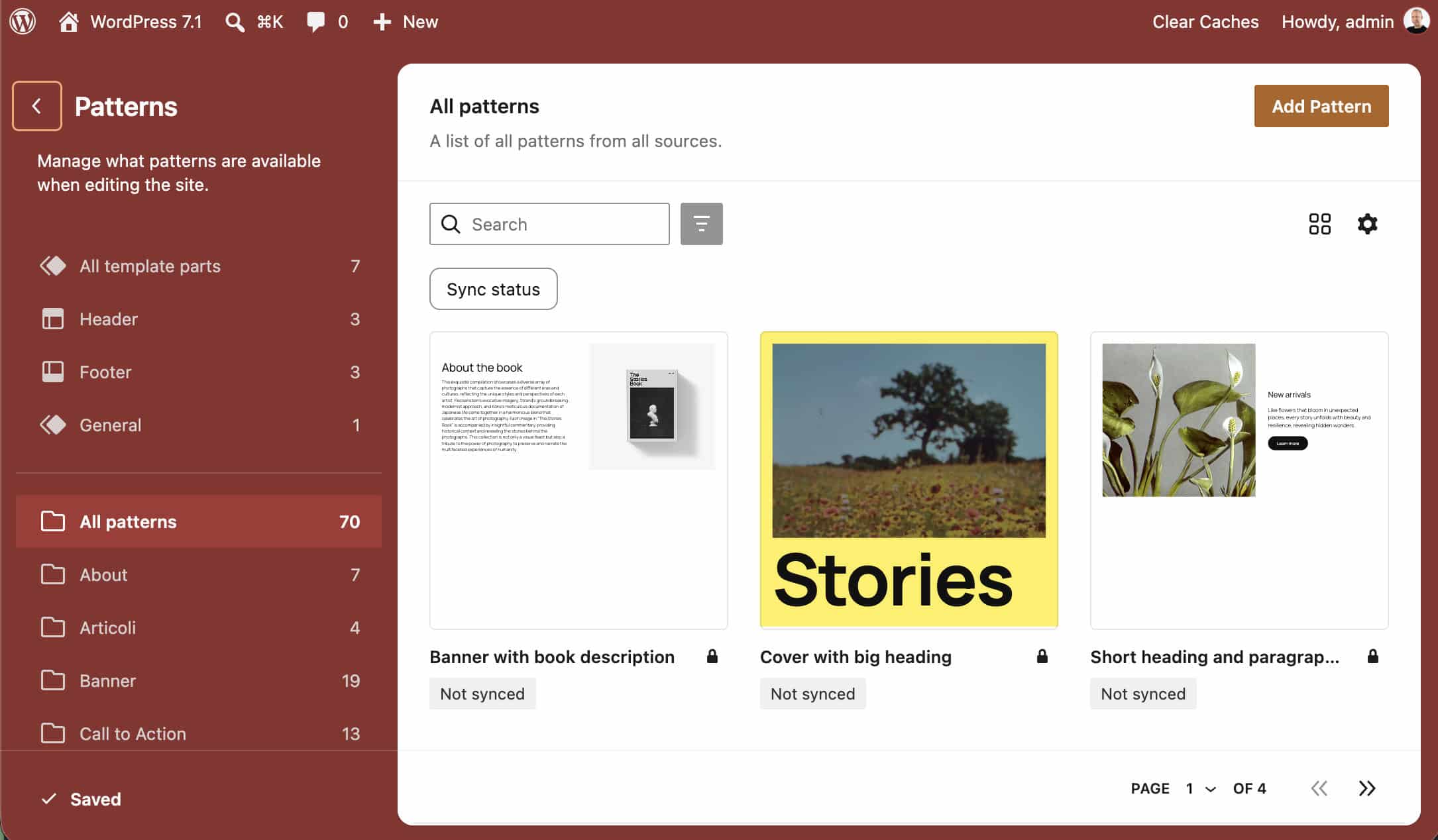
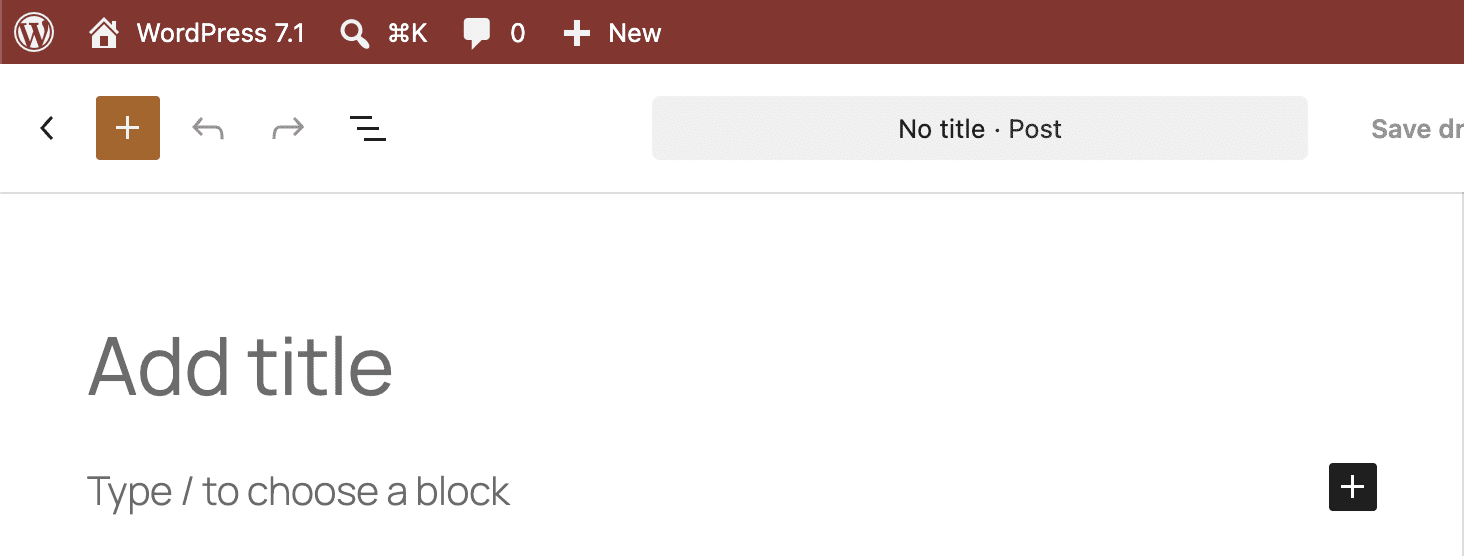
The editor sidebar moreover receives an change with WordPress 7.1. The site icon has been removed from the editor toolbar and now turns out throughout the WordPress toolbar.
In previous permutations, to go back to the WordPress admin, you had to click on at the site icon, which wasn’t technically a once more button.

Because of this, the site icon now turns out only throughout the admin toolbar, while a clearer once more button turns out throughout the editor toolbar.
Command categories and complex command palette UI
The command palette has received plenty of additions and adjustments to toughen its usability. Initially, the available directions were divided into sections (fresh, pointers, and results) to lead them to easier to look out.

The modal has been resized (512px), and the directions these days are easier to be told.

Id visual display unit throughout the Internet web page Editor
A brand spanking new Id products now turns out underneath the Design menu throughout the Internet web page Editor. The corresponding visual display unit implies that you’ll configure your Internet web page identify, tagline, emblem, and icon. This allows you to edit your site’s id settings without leaving the Internet web page Editor.

Numerous Scrolling for the Media Library grid view
Up until WordPress 7.0, it was once possible to allow infinite scrolling for the Media Library grid view at some point of the media_library_infinite_scrolling filter, which was once set to false by means of default. Developers might simply trade the default setting by means of together with the following line to their plugins:
add_filter( 'media_library_infinite_scrolling', '__return_true' );Starting with WordPress 7.1, the media_library_infinite_scrolling filter is able to true, that implies that infinite scrolling throughout the Media Library grid view is energetic for all consumers by means of default.
In addition to, a brand spanking new setting on the individual profile internet web page throughout the WordPress admin implies that you’ll set your infinite scrolling preferences.
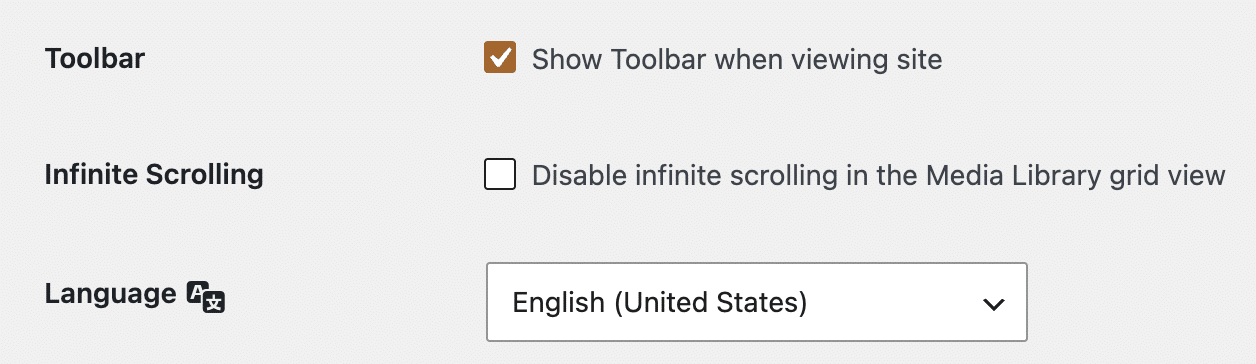
WordPress stores the individual’s variety throughout the individual possible choices using the infinite_scrolling meta key. You’ll retrieve the individual selection this way:
$infinite_scrolling = get_user_option( 'infinite_scrolling', $user_id );Core blocks and block improvements
WordPress 7.1 introduces two new blocks and quite a lot of improvements to present ones.
New Playlist and Tabs Blocks
A new Playlist block allows you to embed a simple playlist in your content material subject matter.

Consumers can customize plenty of facets of the block’s glance, along side typography, background, dimensions, border, and portions. Style controls particular to this block include Waveform & Play button and Waveform background. The Shape keep watch over implies that you’ll switch waveform audio visualization.

The Playlist block is helping all audio knowledge suitable along side your WordPress arrange. When you add toughen for a brand spanking new MIME selection, the block mechanically inherits it.
The new core Tabs block is designed to arrange content material subject matter into tabs. Each tab can come with any block, making it specifically useful for web website hosting content material subject matter categorized by means of topic, FAQs, or product/service comparisons.

Editable blocks all over the Custom designed HTML block
The Custom designed HTML block has received a new enhancement. Now you’ll add editable blocks directly all over the HTML code. This lets you combine static HTML and editable blocks inside the equivalent snippet.

Although they can be edited, editable blocks can’t be moved or removed, nor can additional blocks be added by way of the visual editor. On the other hand, the underlying code remains utterly editable throughout the code editor.
Forward of WordPress 7.1, your content material subject matter had to be each only static HTML or only made up of blocks. Now you’ll freely mix HTML and blocks, which is particularly helpful when generating content material subject matter using AI models.
This variation comes alongside the power in an effort to upload static HTML code to block variations. Because of the new innerContent toughen, you’ll take a look at in a variation of the HTML Code block as confirmed throughout the example underneath:
wp.blocks.registerBlockVariation( 'core/html', {
identify: 'custom-image-card',
determine: 'Custom designed image card',
description: 'A convention HTML block with static header/footer and an editable image.',
innerContent: [
'Static heading
n',
null,
'n'
],
innerBlocks: [
[
'core/image',
{
id: 419,
sizeSlug: 'medium',
linkDestination: 'none',
url: 'https://example.com/wp-content/uploads/...',
alt: ''
}
]
],
} );The null value in innerContent acts as a placeholder for the Image block.
Phrase that innerContent is just available for the Custom designed HTML block. Applying it to variations of other blocks will haven’t any have an effect on.
Improvements to the SVG icon gadget
WordPress 7.0 offered a new Icon block and an Icon library. With WordPress 7.1, the icon keep an eye on gadget includes a public API, enabling icons to be programmatically registered, rendered, and deleted, along with fetched by way of the REST API.
Registering and unregistering icons
To test in an icon or an icon set, you will have to first take a look at in an icon collection by means of hooking the new wp_register_icon_collection() function into the init movement:
function custom_icons_register_icon_collection() {
	wp_register_icon_collection(
		'my-icon-set',
		array(
			'label'       => __( 'My awesome icons', 'my-plugin' ),
			'description' => __( 'My non-public set of icons.', 'my-plugin' ),
		)
	);
}
add_action( 'init', 'custom_icons_register_icon_collection' );
A collection has a singular identify, which distinguishes it from core icons and other icon devices registered by means of third-party plugins. The collection identify will have to get began and end with a lowercase letter and can come with lowercase letters, numbers, hyphens, and underscores.
The function’s 2d argument is an array containing the collection’s label displayed throughout the Icon library and an not obligatory description.
To remove a collection, use the wp_unregister_icon_collection() function. Getting rid of a collection mechanically deletes all icons associated with it.
To test in an individual icon, use the wp_register_icon() function, as confirmed throughout the following example:
wp_register_icon(
	'my-icon-set/motorbike',
	array(
		'label'   => __( 'Motorbike', 'my-plugin' ),
		'content material subject matter' => '...',
	)
);
Inside the example above, we registered an icon using an SVG string. You’ll moreover take a look at in an icon directly from an .svg document:
wp_register_icon(
	'my-icon-set/motorbike',
	array(
		'label'   => __( 'Motorbike', 'my-plugin' ),
		'file_path' => plugin_dir_path( __FILE__ ) . 'icons/motorbike.svg',
	)
);
It is important to phrase that the SVG is sanitized with wp_kses, and only the , , and portions are just lately allowed. All other portions are filtered out, although the allowlist could also be expanded to include additional portions and attributes one day.
To delete an icon, you’ll use the wp_unregister_icon() function.
Icon library and block updates
The Icon library has been up to the moment accordingly and now features a sidebar appearing the list of icon collections registered on the site.


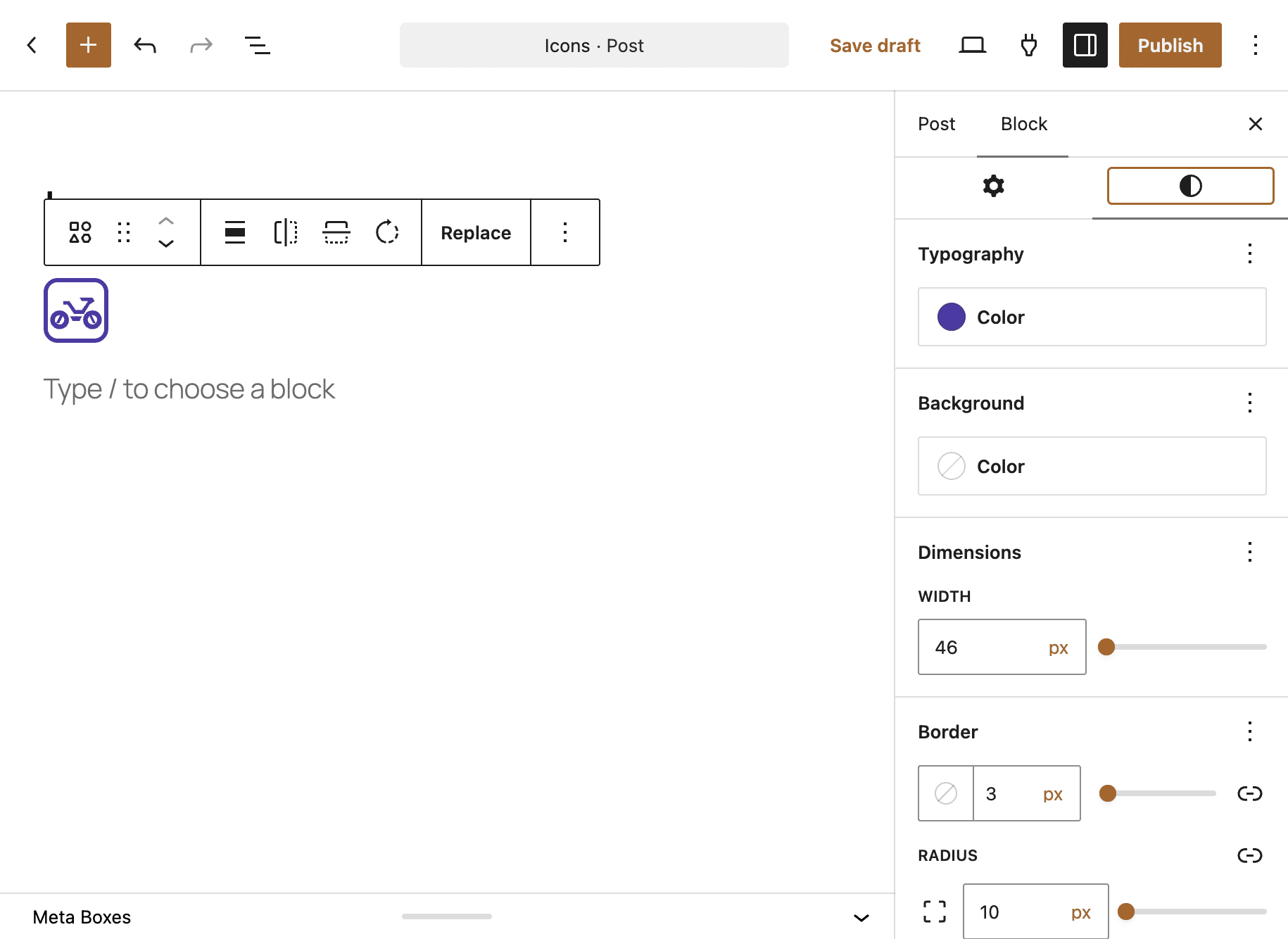
The Icon block has moreover been up to the moment. By the use of default, the block now presentations the Knowledge icon instead of an empty placeholder as in previous permutations. Additionally, two new controls throughout the block toolbar can help you flip the icon vertically and horizontally.
New REST API endpoints for icons
New read-only REST API endpoints have moreover been offered to get entry to icon collections or particular icons.
For icon collections, you will use the following endpoints:
GET /wp/v2/icon-collections
GET /wp/v2/icon-collections/
To be told icons, you will use the following endpoints instead:
GET /wp/v2/icons - Offered with WordPress 7.0.
GET /wp/v2/icons/
GET /wp/v2/icons//
An individual with the edit_posts capability will have to authenticate requests.
For a better evaluate of the Icon gadget in WordPress 7.1, check out the dev word.
New design tools
Creators and editors now have new, complex design tools that allow them style content material subject matter blocks without resorting to custom CSS.
Background gradient toughen
WordPress 7.1 introduces background.gradient strengthen and a brand spanking new admin UI keep watch over for background gradients.
Inside the block settings sidebar, a brand spanking new Background panel with separate controls for Image, Color, and Gradient implies that you’ll experiment with different combos of background photos, colors, and gradients while combating conflicts.

In WordPress 7.1, the background.gradient toughen is enabled by means of default for the Staff, Accordion, Pullquote, Publish Content material subject matter, and Quote blocks. Theme developers can add toughen for background.gradient in block.json by means of together with a gradient assets underneath sorts.background or on a per-block basis, as confirmed throughout the following code:
{
	"sorts": {
		"background": {
			"gradient": "linear-gradient( 135deg, #1e3c72 0%, #2a5298 100% )"
		},
		"blocks": {
			"core/group of workers": {
				"background": {
					"gradient": "linear-gradient( 135deg, #f5f7fa 0%, #c3cf8d 100% )"
				}
			}
		}
	}
}
Minimum width toughen
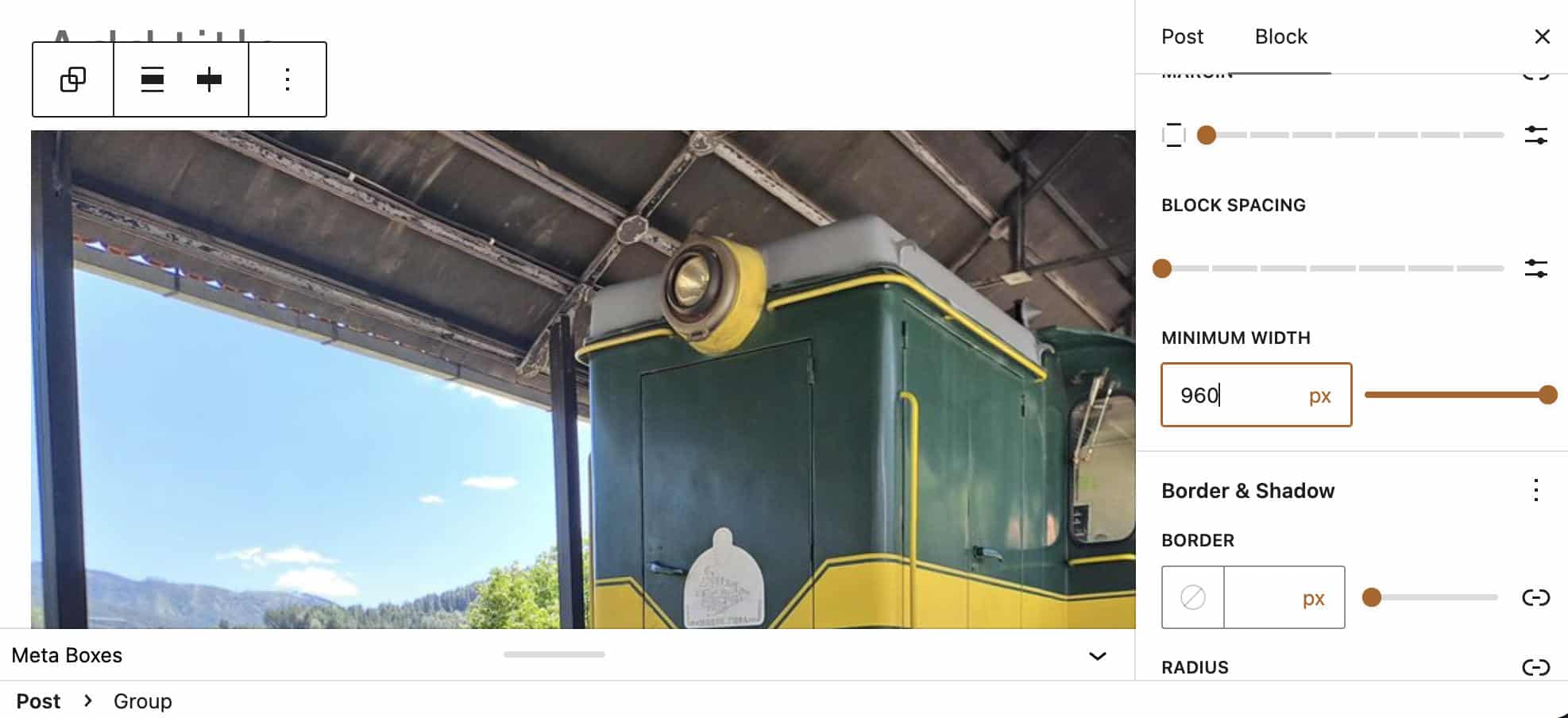
Every other addition coming with WordPress 7.1 that designers and theme developers will love is strengthen for the minWidth measurement. This joins the existing toughen for top, minHeight, and width, completing the set of design tools for dimensions.
Theme developers can add toughen for minimum width by means of theme.json, each by means of enabling Glance Tools or by means of together with the dimensions.minWidth field underneath settings:
{
	"settings": {
		"dimensions": {
			"minWidth": true
		}
	}
}
You’ll moreover add toughen for minimum width globally or on a per-block basis:
{
	"sorts": {
		"dimensions": {
			"minWidth": "400px"
		},
		"blocks": {
			"core/group of workers": {
				"dimensions": {
					"minWidth": "400px"
				}
			}
		}
	}
}
Block developers can in a similar fashion add minWidth toughen to block.json:
{
	"is helping": {
		"dimensions": {
			"minWidth": true
		}
	}
}
The keep watch over is hidden by means of default throughout the sidebar, alternatively you’ll trade the default setting using __experimentalDefaultControls. In Global Sorts, the keep watch over is visible by means of default.
Text shadow toughen in Global Sorts
WordPress 7.1 introduces strengthen for text-shadow in International Types. Previously, you might be able to have sought after a plugin or resorted to custom CSS.
Phrase that this is an preliminary implementation. A few key possible choices are nevertheless pending, harking back to which UI keep watch over to use for customizing text shadows throughout the editor, and whether or not or now not text-shadow should be available as a preset. For now, it’s only possible to stipulate text-shadow in your theme.json in some of the following ways:
{
	"$schema": "https://schemas.wp.org/wp/6.7/theme.json",
	"type": 3,
	"settings": {},
	"sorts": {
		"typography": {
			"textShadow": "1px 1px 2em white, 0 0 2em yellow, 0 0 0.2em red;"
		},
		"blocks": {
			"core/paragraph": {
				"typography": {
					"textShadow": "1px 1px 2px red, 0 0 1em red, 0 0 0.2em red"
				}
			}
		},
		"portions": {
			"h2": {
				"typography": font-size
			}
		}
	}
}
The following image displays the result of the above definitions.

Updates for developers
The updates coming to theme and plugin developers with WordPress 7.1 are exceptional. The a lot of additions and enhancements to the Abilities API and the design gadget theming strike us as necessarily essentially the most noteworthy.
Design gadget theming
WordPress 7.1 introduces a new design machine that plugin developers can use to customize the styling of admin interface portions. The new gadget consists of two parts: Design tokens and a brand spanking new ThemeProvider React component.
Design tokens
WordPress design tokens are CSS tradition homes that practice an established construction. Proper right here, for example, is the advance for the Color token family:
--wpds-color---[-][-]Consistent with the advance above, the following variable devices the background colour for surfaces with common emphasis:
--wpds-color-background-surface-neutral-strongStarting with WordPress 7.1, design tokens can be used by means of any plugin that generates admin interface portions as a result of a brand spanking new wp-theme stylesheet that includes a entire set of semantic design tokens and is available as a plugin dependency. You’ll enqueue a practice stylesheet that uses wp-theme as confirmed underneath:
function myplugin_enqueue_admin_assets( $hook_suffix ) {
	wp_enqueue_style(
		'myplugin-admin-style',
		plugin_dir_url( __FILE__ ) . 'assets/css/admin.css',
		array( 'wp-theme' ),
		'1.0.0'
	);
}
add_action( 'admin_enqueue_scripts', 'myplugin_enqueue_admin_assets' );
The benefit of design tokens is that they can exchange hard-coded CSS assets values. See the following example from the dev phrase:
.card {
	background-color: var(--wpds-color-background-surface-neutral-strong);
	colour: var(--wpds-color-foreground-content-neutral);
	border: var(--wpds-border-width-xs) solid var(--wpds-color-stroke-surface-neutral-weak);
	border-radius: var(--wpds-border-radius-lg);
	padding: var(--wpds-dimension-padding-2xl);
}
Design tokens can be used along side the ThemeProvider component to customize the illusion of particular areas of the admin internet web page.
ThemeProvider
You’ll override the default design token values equipped by means of the wp-theme stylesheet by means of wrapping the admin area’s content material subject matter all over the brand new ThemeProvider React component, as confirmed throughout the following example from the dev phrase:
import { ThemeProvider } from '@wordpress/theme';
import { Card } from '@wordpress/ui';

function Device() {
	return (


					Card content material subject matter


	);
}
Given a primary and a background seed colour, the component mechanically generates a harmonious and loyal colour ramp that provides to be had difference between individual interface portions.
The ThemeProvider we could in plugin developers to express their logo id inside interface areas while ultimate consistent with the entire style of the WordPress admin interface.
For a better analysis, please take a look at with the dev word and the respected documentation on design tokens and ThemeProvider.
Enhancements to the Abilities API
With the release of WordPress 7.1, the Talents API receives plenty of additions that stretch its capacity.
New execution lifecycle for the Abilities API
Initially, the execution cycle is enhanced with 4 new filters that run previous to, all the way through, and after an ability’s execution.
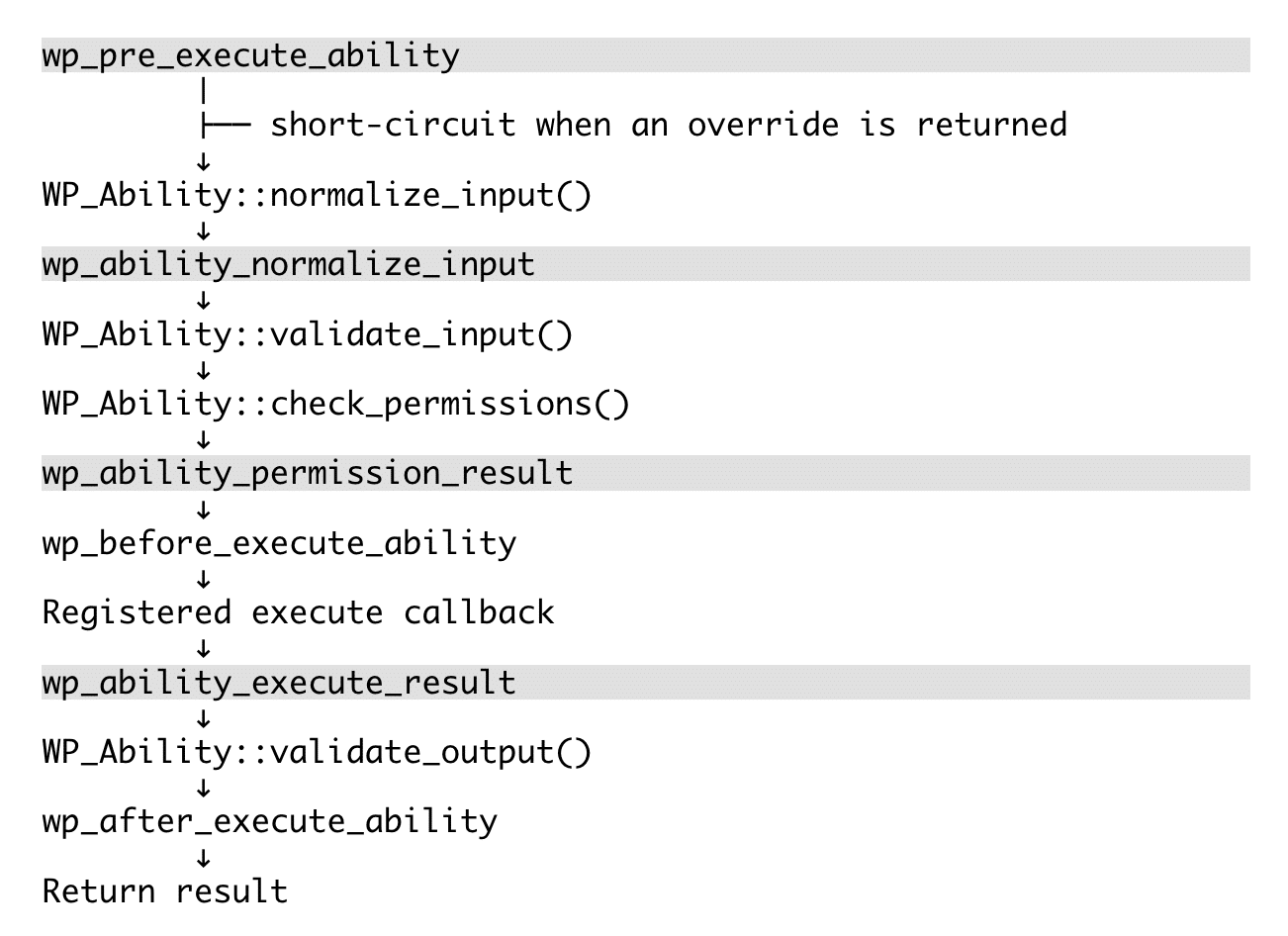
The wp_pre_execute_ability filter runs at the beginning of WP_Ability::execute() and is used to intercept and short-circuit the execution of an movement even previous to WordPress starts processing it. If the filter returns a value quite then the default $pre value (an error, knowledge, or a boolean), WordPress stops straight away, bypasses exams, and returns that value.
This filter lends itself to attention-grabbing use circumstances, harking back to disabling an ability all the way through site upkeep, value limiting requests originating from the equivalent IP, or mocking an ability’s response (Unit Testing).
The wp_ability_normalize_input filter runs correct after default values are carried out and previous to formal schema validation and permission exams. It’s used to arrange or change into incoming knowledge previous to it’s validated and processed by means of the power—for example, together with contextual metadata, normalizing knowledge previous to validation, enriching an AI recommended, or halting ability execution in case of an error.
The wp_ability_permission_result filter allows you to regulate the result of permission exams performed previous to executing an ability. You’ll use it in an effort to upload further fine-grained authorization laws, create a practice permission gadget, or bypass permissions in particular circumstances.
Phrase that you’ll use this filter with caution:
Plugins should exercise explicit care with this filter on account of returning
truecan override a denial from the power’s uniquepermission_callback.
The wp_ability_execute_result filter runs after the power’s execution callback and previous to output validation, allowing you to modify the total finish outcome returned by means of an ability. It means that you can change into the response produced by means of the power’s processing previous to it’s returned to the caller.
Filtering and manipulating abilities
Forward of WordPress 7.1, filtering registered abilities required manually iterating over the registry using array_filter(). Starting with WordPress 7.1, wp_get_abilities() accepts an not obligatory array of arguments to filter registered abilities by means of elegance, namespace, meta, or a mix of the ones.
The following example displays the best way to retrieve abilities belonging to a decided on elegance:
$abilities = wp_get_abilities(
	array(
		'elegance' => 'content-generation',
	)
);
You’ll moreover combine a few parameters:
$abilities = wp_get_abilities(
	array(
		'elegance'  => 'content-generation',
		'meta'      => array(
			'public' => true,
		),
	)
);
For added advanced filtering, the API provides the item_include_callback and result_callback parameters—two callbacks used to include or exclude abilities from the array and to type or manipulate the outcome set previous to it’s returned.
At the side of the updates to wp_get_abilities(), WordPress 7.1 introduces two new international filters:
wp_get_abilities_item_include: Runs for each and every ability that passes the declarative filters anditem_include_callback. You’ll use this filter to include or exclude particular abilities site-wide.wp_get_abilities_result: Runs afterresult_callback. You’ll use it to keep an eye on all of the finish outcome set of abilities across the site.
Consult with the dev word for a better evaluate of the updates to wp_get_abilities() and its comparable filters.
New public exposure flag
WordPress 7.1 moreover introduces a new metadata flag to indicate {that a} capacity is available for get entry to by means of external clients, such for the reason that REST API, MCP adapters, and AI agents.
When registering an ability, you’ll now use meta.public to allow your ability to be found out and invoked at some point of the REST abilities endpoints. Previously, you had to specify exposure separately for each channel—for example, by means of setting ‘show_in_rest’ => true to make an ability visible by way of REST.
Other improvements to the Abilities API
At the side of the updates noticed above, WordPress 7.1 introduces additional improvements overlaying quite a lot of facets of the API.
Two new filters, wp_ability_validate_input and wp_ability_validate_output, allow plugins to validate input and output knowledge using further complex laws than those expressible by means of the WordPress JSON Schema. The main filter runs after the input has been able and initial schema validation has passed. The second filter runs after the power has carried out and previous to the total outcome’s returned.
The wp_ability_invoked movement runs at the beginning of WP_Ability::execute() and can be used to track and log each and every attempt to invoke an ability. You’ll hook into this movement to log get entry to makes an try to a decided on ability, measure server load, prepare daily or monthly usage counters, and come across brute-force title makes an strive.
Be careful, although:
The movement receives raw, unnormalized input. Plugins should due to this fact avoid logging input indiscriminately, on account of it’ll come with credentials, non-public knowledge, or other subtle knowledge.
Further updates for developers
The updates for developers don’t end proper right here. WordPress 7.1 brings a very good number of improvements and additions, providing new and additional unswerving building tools. With this new free up, you’ll moreover to seek out:
- 4 new filters to configure the Web page Editor monitors
- Put up editor all the time iframed
- Updates to editor elements
- jQuery UI up to date to one.14.2
- JSON Schema preparation for Jstomer compatibility.
- Customers can now observe types to pseudo states.
- Responsive block types and configurable viewports
- New purposes for rendering tooltips and informational lend a hand

Next-gen web website hosting for next-gen WordPress
WordPress 7.1 marks a vital step forward for the CMS all over plenty of fronts.
Shopper-side media processing represents a turning degree in image keep an eye on. Processing now occurs on the client side, main to raised server helpful useful resource efficiency and faster internet web page potency.
As for AI purposes, following the groundbreaking updates in 6.9 and 7.0, WordPress 7.1 marks a 2nd of consolidation. The Abilities API options new choices that allow developers to build further unswerving and protected AI integrations and purposes.
Every other powerful addition that developers and companies will acknowledge is the Theme Provider, which allows plugins to express their logo id throughout the admin area while staying consistent with the WordPress dashboard interface.
There are also enhancements to Notes, new blocks, a further powerful SVG icon gadget, and much more. In brief, WordPress is some distance from slowing down and is further forward-looking than ever.
For an increasingly advanced CMS, choosing a web website hosting provider that keeps pace with trendy technologies is essential. Kinsta offers the most efficient setting for next-generation WordPress web sites: containerized cloud infrastructure, stellar potency, solid protection, and rapid, top-rated toughen.
When you haven’t tried our web website hosting however, benefit from the loose trial on made up our minds on plans or touch us to be told further.
The publish What’s new in WordPress 7.1: Consumer-side media processing, design gear, Talents API, and a lot more gave the impression first on Kinsta®.



0 Comments